
Chemical equilibrium
Shift an equilibrium with Fe³⁺ and SCN⁻, then with cobalt chloride: the procedure, observation tables, Le Chatelier's principle and the viva.
By Rahul Sain · Updated Nov 5, 2026
 Free 3D labTry it in the 3D labChemical equilibrium: take the readings yourself, free, no sign-in needed.
In the Class 11 chemical equilibrium practical you change the concentration of one substance in an equilibrium mixture and watch its colour move. Add more ferric ions or more thiocyanate ions to a dilute blood red solution and it turns deeper red. Add water to cobalt chloride in acetone and it turns from blue to pink; add concentrated hydrochloric acid and it goes back towards blue. Each change is Le Chatelier's principle at work.
This guide follows the NCERT Laboratory Manual Chemistry Class XI (Unit 4, Experiments 4.1 and 4.2), NCERT Chemistry Part I, Unit 6 and the CBSE Chemistry syllabus for 2026-27. It is laid out the way a practical file is written.
Quick answers
- What CBSE lists: practical D, "Chemical Equilibrium", any one of two experiments: the shift in equilibrium between ferric and thiocyanate ions, or between [Co(H₂O)₆]²⁺ and chloride ions, by changing the concentration of either ion.
- The two equations: Fe³⁺(aq) + SCN⁻(aq) ⇌ [Fe(SCN)]²⁺(aq), blood red. [Co(H₂O)₆]²⁺(aq) + 4Cl⁻(aq) ⇌ [CoCl₄]²⁻(aq) + 6H₂O(l), pink to blue.
- The rule: add a reactant and the equilibrium shifts forward; remove one and it shifts back. Only temperature changes the equilibrium constant K.
- Temperature: the cobalt reaction's forward direction is endothermic, so heating turns it bluer and a freezing mixture turns it pink.
- Most common viva question: "Does adding Fe³⁺ change K?" No. It makes Q smaller than K, and the reaction runs forward until Q equals K again.
Where this practical sits in each syllabus
CBSE Class 11. Section D of the 2026-27 syllabus gives the two experiments above and asks for any one. It counts as a content-based experiment in the practical exam. The Delhi Directorate of Education's 2026-27 Class 11 syllabus uses the same words.
NCERT. The lab manual's Unit 4 has both experiments. The textbook covers the theory in Unit 6, section 6.8, "Factors Affecting Equilibria", with the same ferric thiocyanate experiment and the cobalt chloride temperature effect.
ISC Class 11. Unit 6, Equilibrium, discusses the factors that affect an equilibrium in the light of Le Chatelier's principle. There is no equilibrium practical in the ISC paper.
IGCSE 0620. Topic 6.3 of the 2026-2028 syllabus covers reversible reactions, including the effect of water and heat on cobalt(II) chloride, and predicting the position of equilibrium. Anhydrous cobalt(II) chloride is also IGCSE's test for water: blue turns pink.
Aim
- To study the shift in equilibrium between ferric ions and thiocyanate ions by increasing the concentration of either ion.
- To study the shift in equilibrium between [Co(H₂O)₆]²⁺ and chloride ions by changing the concentration of either ion.
Theory
A dynamic equilibrium
When ferric ions and thiocyanate ions are mixed, they join to form the blood red complex ion [Fe(SCN)]²⁺, and the complex also splits back into the two ions. At equilibrium both reactions are still going on, at the same rate, so the colour stops changing. Nothing has stopped: it is a dynamic equilibrium.
Fe³⁺(aq) + SCN⁻(aq) ⇌ [Fe(SCN)]²⁺(aq) (pale yellow) (colourless) (blood red)
In water the iron ion is really [Fe(H₂O)₆]³⁺, and thiocyanate takes the place of one water molecule, so the full equation is [Fe(H₂O)₆]³⁺ + SCN⁻ ⇌ [Fe(H₂O)₅(SCN)]²⁺ + H₂O.
The equilibrium constant and Q
K = [Fe(SCN)²⁺] ÷ ([Fe³⁺][SCN⁻])
At a fixed temperature K has one value, whatever amounts you start with. The same expression worked out at any moment, not only at equilibrium, is the reaction quotient Q. NCERT's rule: if Q is less than K the reaction goes forward; if Q is greater than K it goes backward; when Q equals K the mixture is at equilibrium.
Le Chatelier's principle
NCERT states it as: "a change in any of the factors that determine the equilibrium conditions of a system will cause the system to change in such a manner so as to reduce or to counteract the effect of the change."
So when you add more Fe³⁺, Q falls below K, and more Fe³⁺ and SCN⁻ join up until Q is back up to K. The new mixture holds more of the red ion, so it looks deeper red. The shift does not undo the change completely: there is still more Fe³⁺ than before you added it.
The cobalt chloride equilibrium
[Co(H₂O)₆]²⁺(aq) + 4Cl⁻(aq) ⇌ [CoCl₄]²⁻(aq) + 6H₂O(l) (pink) (colourless) (blue)
Cobalt here is Co²⁺. One printing of the NCERT textbook shows [Co(H₂O)₆]³⁺ in section 6.8.4; the lab manual and CBSE both write 2+, which is correct.
Adding chloride (concentrated HCl) pushes it forward, towards blue. Adding water pushes it back, towards pink. The forward reaction absorbs heat, so warming it shifts it forward (bluer) and cooling it shifts it back (pinker). Temperature is the only change that alters K itself.
Apparatus and chemicals
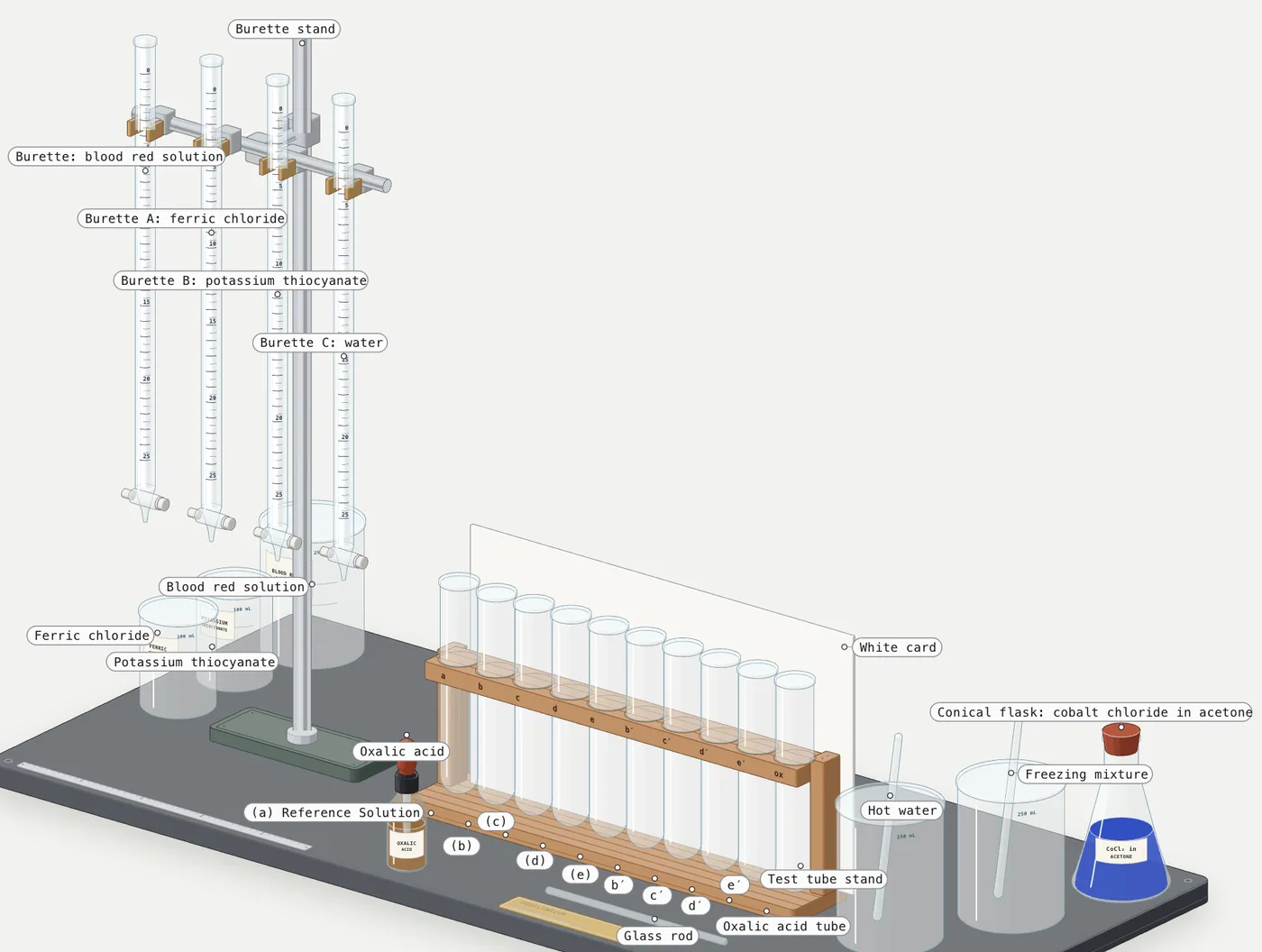
Experiment 4.1 (NCERT's list): beakers (100 mL), two; beaker (250 mL), one; boiling tubes; burettes, four; glass droppers, two; test tube stand; glass rod. Ferric chloride (0.100 g in 100 mL water), potassium thiocyanate (0.100 g in 100 mL water) and distilled water.
Experiment 4.2 (NCERT's list): conical flask (100 mL); beakers (100 mL), three; burettes, three; test tubes, six; test tube stand; glass rod. Cobalt chloride (0.6000 g in 60 mL acetone), acetone, concentrated hydrochloric acid and distilled water. For the temperature effect add a beaker of hot water (about 50 °C) and a beaker of freezing mixture.
Procedure
Experiment 4.1: ferric ions and thiocyanate ions
- Dissolve 0.100 g of ferric chloride in 100 mL of distilled water, and 0.100 g of potassium thiocyanate in another 100 mL.
- Mix 20 mL of each in a 250 mL beaker. The mixture is blood red. Fill a burette with it.
- Label five boiling tubes a, b, c, d and e, and run 2.5 mL of the blood red solution into each.
- Add 17.5 mL of water to tube a. This is the reference solution; keep it to compare the others against.
- Fill burette A with ferric chloride, burette B with potassium thiocyanate and burette C with water.
- Add 1.0, 2.0, 3.0 and 4.0 mL of ferric chloride to tubes b, c, d and e, then water to make each tube up to 20 mL (16.5, 15.5, 14.5 and 13.5 mL).
- Stir each tube with a clean glass rod and compare its colour with tube a, side by side against a white background.
- Repeat with four more tubes, b′ to e′, adding potassium thiocyanate instead of ferric chloride.
Taking an ion away. NCERT's textbook also shows the reverse: oxalic acid binds Fe³⁺ as the ion [Fe(C₂O₄)₃]³⁻, so the red complex splits up and the colour fades.
Experiment 4.2: cobalt and chloride ions
- Dissolve 0.6000 g of cobalt chloride in 60 mL of acetone in a conical flask. The solution is blue.
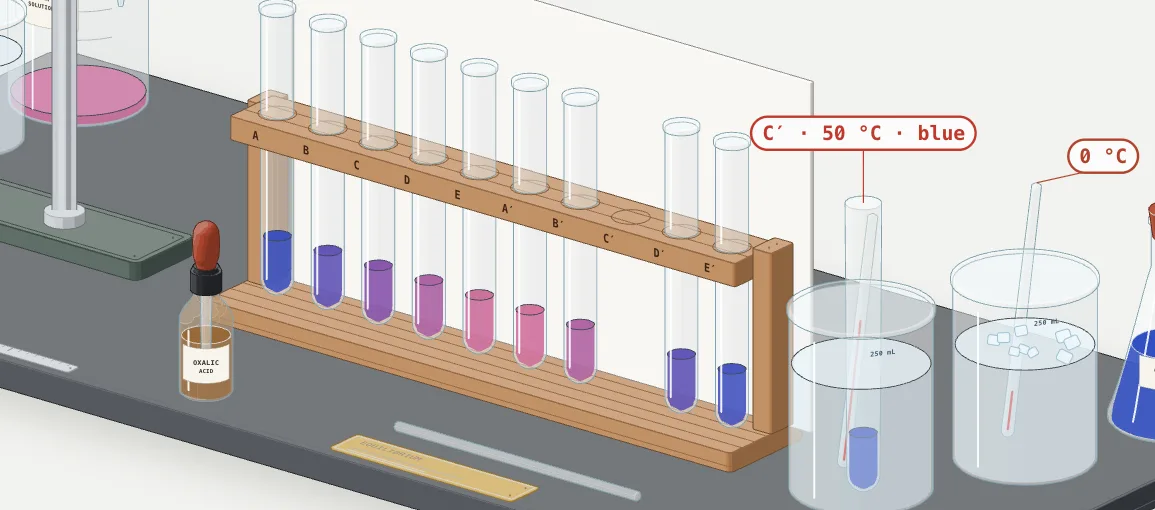
- Into test tubes A to E put 3.0 mL of this solution, then the acetone and water in the table below, so each holds 4.0 mL. Note how the colour moves from blue to pink as the water increases.
- Make a pink solution: 10 mL of the cobalt chloride solution plus 5 mL of distilled water.
- Into tubes A′ to E′ put 1.5 mL of the pink solution, then concentrated HCl and water as in the second table, again 4.0 mL each. Note how pink moves towards light blue as the acid increases.
- To see the effect of temperature, stand one tube in hot water and then in a freezing mixture, and watch its colour change each way.
Observation tables
Table 1: adding ferric chloride (NCERT Table 4.1)
Each tube holds 2.5 mL of blood red solution and is made up to 20 mL. The amounts of the red ion are worked out with K = 138 M⁻¹, a typical value at 25 °C used by the 3D lab; your tubes show the same trend by eye.
| Tube | Ferric chloride added (mL) | Water added (mL) | Colour against tube a | Red ion (µM) | Times tube a |
|---|---|---|---|---|---|
| a (reference) | 0.0 | 17.5 | reference | 30.1 | 1.00 |
| b | 1.0 | 16.5 | deeper red | 52.3 | 1.74 |
| c | 2.0 | 15.5 | deeper still | 73.1 | 2.43 |
| d | 3.0 | 14.5 | deeper still | 92.5 | 3.08 |
| e | 4.0 | 13.5 | deepest | 110.8 | 3.68 |
Table 2: adding potassium thiocyanate (NCERT Table 4.2)
| Tube | Potassium thiocyanate added (mL) | Water added (mL) | Red ion (µM) | Times tube a |
|---|---|---|---|---|
| b′ | 1.0 | 16.5 | 51.0 | 1.70 |
| c′ | 2.0 | 15.5 | 69.8 | 2.32 |
| d′ | 3.0 | 14.5 | 86.6 | 2.88 |
| e′ | 4.0 | 13.5 | 101.7 | 3.38 |
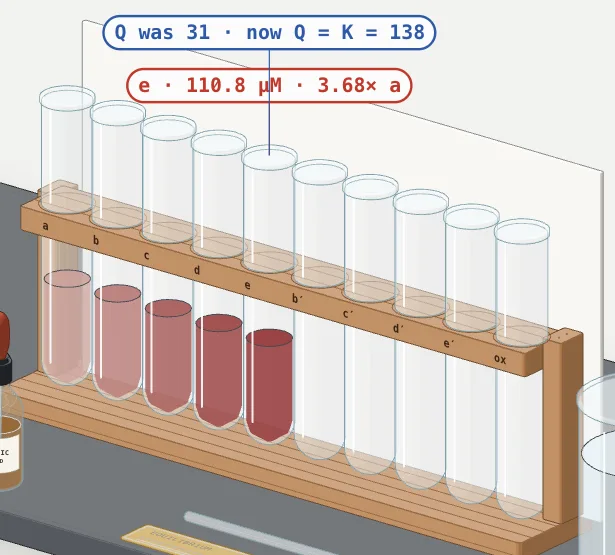
Why tube a is so pale. Diluting 2.5 mL of the blood red mixture to 20 mL would leave 138 µM of the red ion if nothing shifted. Only 30.1 µM is left, because dilution also shifts the equilibrium back. That is why the manual warns that the colour "will decrease very much on dilution".
Table 3: adding water to cobalt chloride in acetone (NCERT Table 4.3)
| Tube | Cobalt chloride solution (mL) | Acetone (mL) | Water (mL) | Colour |
|---|---|---|---|---|
| A | 3.0 | 1.0 | 0.0 | blue |
| B | 3.0 | 0.8 | 0.2 | blue-violet |
| C | 3.0 | 0.6 | 0.4 | violet |
| D | 3.0 | 0.4 | 0.6 | pink-violet |
| E | 3.0 | 0.2 | 0.8 | pink |
Table 4: adding hydrochloric acid to the pink solution (NCERT Table 4.4)
| Tube | Pink solution (mL) | Conc. HCl (mL) | Water (mL) | Colour |
|---|---|---|---|---|
| A′ | 1.5 | 0.5 | 2.0 | pink |
| B′ | 1.5 | 1.0 | 1.5 | pink-violet |
| C′ | 1.5 | 1.5 | 1.0 | violet |
| D′ | 1.5 | 2.0 | 0.5 | blue-violet |
| E′ | 1.5 | 2.5 | 0.0 | light blue |
The in-between colours are approximate: exactly which tube looks violet depends on your solutions and the light.
Result
- Increasing the concentration of either Fe³⁺ or SCN⁻ shifts the equilibrium Fe³⁺ + SCN⁻ ⇌ [Fe(SCN)]²⁺ in the forward direction, so the red deepens from tube b to tube e and from b′ to e′.
- Increasing the concentration of water shifts [Co(H₂O)₆]²⁺ + 4Cl⁻ ⇌ [CoCl₄]²⁻ + 6H₂O backward (blue to pink); increasing the concentration of chloride shifts it forward (pink to light blue).
Precautions
From the NCERT manual:
- Use very dilute solutions of ferric chloride and potassium thiocyanate, or the differences in red are too deep to see.
- Compare each tube with the reference tube side by side.
- Judge the colours in diffused daylight, against a white background.
- Use boiling tubes of the same size, so you look through the same depth of liquid.
- Use distilled water, and add water and solutions from a burette or graduated pipette.
- Keep the total volume the same in every tube, so only one concentration changes.
Safety:
- Avoid contact of ferric chloride with skin and eyes, and wear safety spectacles.
- Acetone is flammable: keep its bottle closed and away from flames. Warm the cobalt mixture in hot water, never over a burner (acetone boils at 56 °C).
- Concentrated hydrochloric acid is corrosive. Add it only from a burette, and wash any splash off at once with plenty of water.
- Do this experiment only in a school lab under supervision, never at home.
Common mistakes
| Mistake | What goes wrong |
|---|---|
| Different total volumes in the tubes | Dilution itself shifts the equilibrium, so the colours no longer show only the ion you added |
| Not keeping tube a | Nothing to compare against, and small differences can't be judged |
| Strong solutions | Every tube is so dark that the trend can't be seen |
| Tubes of different widths | A wider tube looks darker even with the same solution |
| Saying "the reaction has stopped" at equilibrium | Both reactions are still going on at the same rate |
| Saying adding Fe³⁺ changes K | K changes only with temperature; adding an ion changes Q |
Viva questions with answers
- State Le Chatelier's principle. If a condition of a system at equilibrium is changed, the system shifts so as to reduce the effect of the change.
- Why does tube e look deeper red than tube a? It has more Fe³⁺, so Q is below K and the reaction runs forward, making more [Fe(SCN)]²⁺ until Q equals K again.
- Does adding Fe³⁺ change the equilibrium constant? No. K changes only with temperature. Adding an ion changes the position of equilibrium, not K.
- What is the use of tube a? It is the reference: the equilibrium you compare every other tube with.
- Why are dilute solutions used? A strong solution is so dark red that differences between tubes can't be seen.
- Why should every tube have the same total volume? Dilution also shifts the equilibrium, so only the ion you are studying should change.
- Why boiling tubes of the same size? The depth of liquid you look through must be the same for a fair comparison of colour.
- How can you make the red colour fade? Remove Fe³⁺ with oxalic acid (it forms [Fe(C₂O₄)₃]³⁻) or dilute the solution: both shift the equilibrium backward.
- What are the colours of the species? Fe³⁺ pale yellow, SCN⁻ colourless, [Fe(SCN)]²⁺ blood red; [Co(H₂O)₆]²⁺ pink, [CoCl₄]²⁻ blue.
- What happens when the cobalt mixture is heated? The forward reaction is endothermic, so heating shifts it forward and the colour turns bluer. Cooling in a freezing mixture turns it pink.
- Can sodium chloride solution replace concentrated HCl? Not well. Its chloride concentration is far lower, and its water pushes the equilibrium back towards pink.
- Is equilibrium static or dynamic? Dynamic: the forward and backward reactions go on at equal rates, so the amounts stay constant without being equal.
Try it in 3D
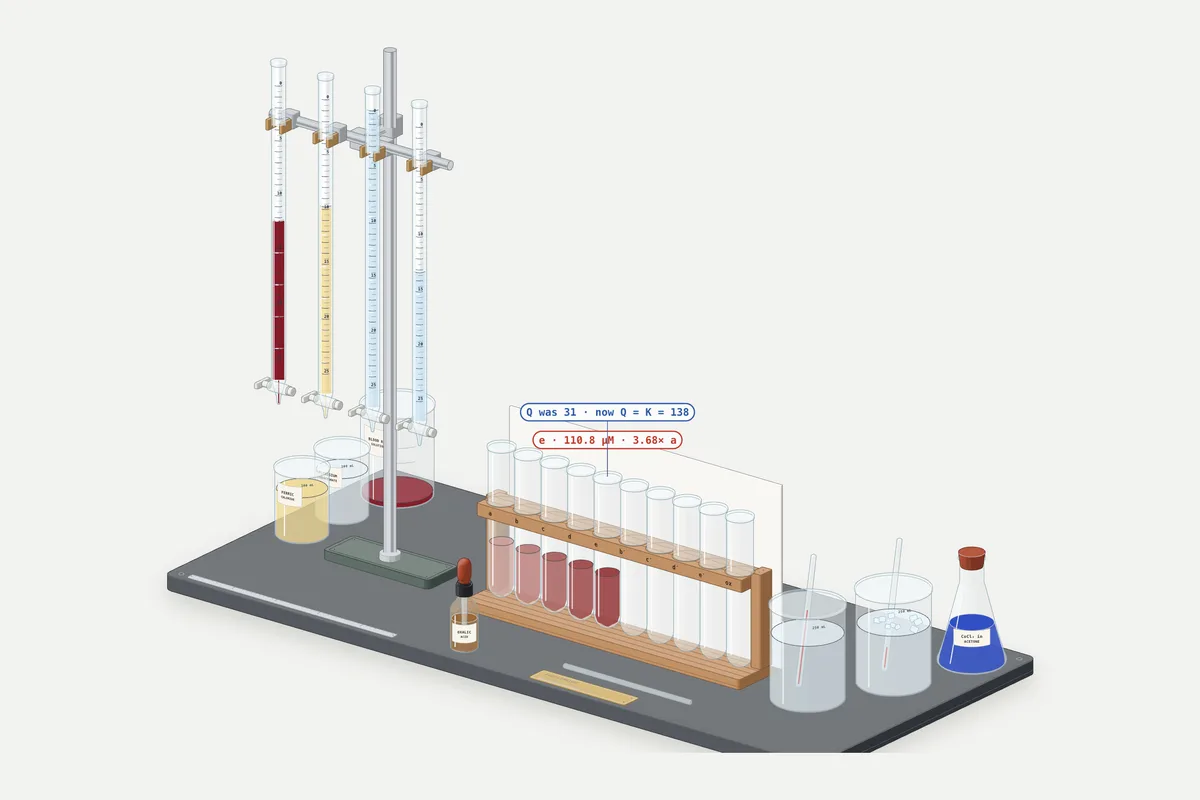
The Student Intelligence chemical equilibrium lab is a 3D bench you can turn all the way round, with four burettes over a test tube stand, a white card behind the tubes and the cobalt chloride flask beside its hot and ice baths. On it you can:
- Make the blood red solution and fill the reference tube a.
- Fill tubes b to e and b′ to e′ from the burettes, and hold any tube beside tube a to compare. Each tube shows its red ion in µM and how many times tube a it is.
- Watch Q come back to K. Adding the extra iron to tube e drops Q to 31; the bench shows it rising back to K = 138 as the red deepens.
- Take the iron away with drops of oxalic acid and watch the red fade to pale yellow.
- Switch to cobalt chloride: grade tubes A to E with water, tubes A′ to E′ with hydrochloric acid, then move a tube between the hot bath and the freezing mixture.
- Look inside. A see-through window shows the ions joining and splitting, with the forming and splitting rates settling to equal.
The bench and its controls are free to use without an account. The guided experiment with the tutor needs a free sign-in.
FAQ
Which equilibrium experiment do I need for CBSE Class 11?
Either one: CBSE's practical D asks for any one of the ferric thiocyanate experiment or the cobalt chloride experiment.
Why does adding water make cobalt chloride pink?
Water is a product of the forward reaction. Adding more of it shifts the equilibrium backward, towards the pink [Co(H₂O)₆]²⁺ ion.
Does a catalyst shift an equilibrium?
No. A catalyst speeds up the forward and backward reactions equally, so the mixture reaches equilibrium sooner, but the position of equilibrium and K stay the same.
At equilibrium, are the amounts of reactants and products equal?
No, they are only constant. In tube a there is far more free Fe³⁺ and SCN⁻ than red complex, yet it is at equilibrium.
If you want to check your understanding before the practical exam, explaining the steps aloud to Student Intelligence's tutor is one way to find the gaps.
Sources
- Central Board of Secondary Education. Chemistry (043), Classes XI-XII, 2026-27 (curriculum). https://cbseacademic.nic.in/web_material/CurriculumMain27/SecPart2/Chemistry_SecP2_2026-27.pdf
- NCERT. Laboratory Manual Chemistry Class XI, Unit 4: Chemical Equilibrium (Experiments 4.1 and 4.2). https://ncert.nic.in/pdf/publication/sciencelaboratorymanuals/classXI/chemistry/kelm204.pdf
- NCERT. Chemistry Part I, Class XI, Unit 6: Equilibrium (section 6.8, Factors Affecting Equilibria). https://ncert.nic.in/textbook/pdf/kech106.pdf
- Directorate of Education, Government of NCT of Delhi. Class XI Chemistry syllabus 2026-27. https://edustud.nic.in/edu/Syllabus_2026_27/11/11_chemistry_SYLLABUS_2026_27_EM.pdf
- Cambridge International. Cambridge IGCSE Chemistry 0620, syllabus for 2026-2028. https://www.cambridgeinternational.org/Images/697205-2026-2028-syllabus.pdf