
Flame test
Identify a metal ion from the colour it gives a flame, with the colour chart, the NCERT procedure and viva answers.
By Rahul Sain · Updated Nov 3, 2026
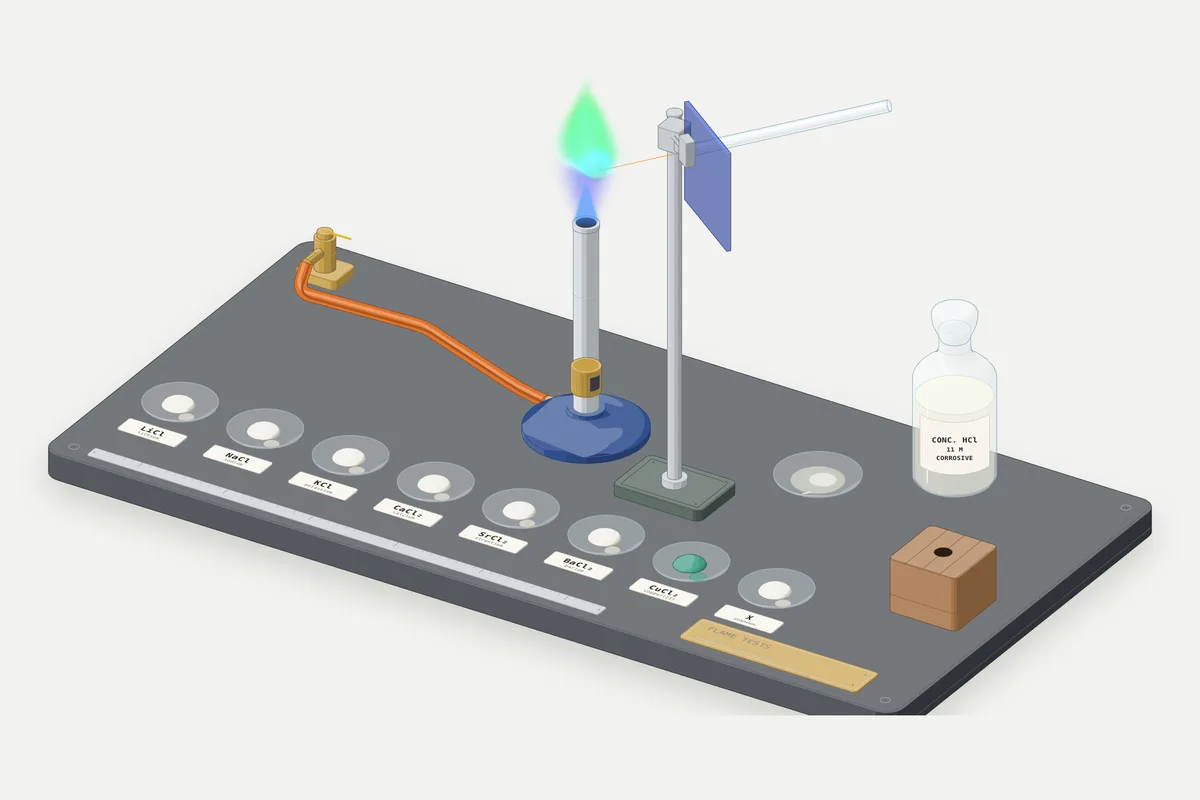 Free 3D labTry it in the 3D labFlame tests: take the readings yourself, free, no sign-in needed.
In a flame test you hold a little of a salt on a clean platinum wire in a non-luminous flame and note the colour. Each metal ion gives its own colour: calcium brick red, strontium crimson red, barium apple green and copper green with a blue centre, as the NCERT lab manual lists them (NCERT Lab Manual XII, Unit 7). Sodium gives yellow, potassium lilac and lithium red (Cambridge IGCSE Chemistry 0620 syllabus).
This guide follows the NCERT procedure and gives the full flame test chart, including colours through blue glass, and viva answers. In CBSE it is a preliminary test in salt analysis, so read it alongside the salt analysis guide.
Quick answers
- Flame test colours: Na⁺ golden yellow, K⁺ lilac, Ca²⁺ brick red, Sr²⁺ crimson red, Ba²⁺ apple green, Cu²⁺ green with a blue centre, Li⁺ red.
- Why HCl is used: it turns the salt into its chloride, which is volatile in the flame. It also cleans the wire.
- Why cobalt glass is used: it absorbs the yellow of sodium, which is in almost every sample, so the faint colour of potassium can be seen.
- Why the colours appear: heat lifts electrons to higher energy levels; when they fall back they give out light of fixed wavelengths, which is the colour.
- In salt analysis: a preliminary test only. Confirm the ion with its wet test.
Where the flame test is in your syllabus
| Board | Class | What it asks |
|---|---|---|
| CBSE | 11 and 12 | Salt analysis practical ("Determination of one anion and one cation in a given salt"); the flame test is a preliminary test in NCERT Unit 7 and part of the group V confirmatory tests |
| ICSE | 9 | Internal assessment practical: flame test to identify the metal in a sodium salt, a potassium salt and a calcium compound |
| Cambridge IGCSE (0620) | 9 and 10 | Describe the flame test for Li⁺, Na⁺, K⁺, Ca²⁺, Ba²⁺ and Cu²⁺ |
The CBSE 2026-27 cation list includes Cu²⁺, Ca²⁺, Sr²⁺ and Ba²⁺, the four ions NCERT's flame test table covers. Na⁺, K⁺ and Li⁺ are not on the CBSE list (CBSE Curriculum 2026-27). In the ICSE 2027 syllabus the flame test sits in the Class IX practical list; the Class X practical list does not name it (CISCE ICSE Chemistry 2027). The IGCSE list and colours are in section 12.5 and the notes table of the IGCSE 0620 syllabus.
Aim
To identify the metal ion in a given salt from the colour it gives to a non-luminous flame.
Theory: why metal ions colour a flame
In plain words. The flame heats the salt until it turns to vapour. Heat gives the metal's electrons extra energy and pushes them up to a higher energy level. They do not stay there. When an electron drops back, it gives out the extra energy as light. The gap between the two levels is fixed for each element, so the light has a fixed colour. Different metals have different gaps, so they give different colours.
The textbook version. NCERT Class 11 Chapter 2 explains that atoms which absorb energy are "excited" and, on returning to their lower energy state, emit radiation. This emitted radiation is called an emission spectrum. Each element has a unique line emission spectrum, which can identify it the way a fingerprint identifies a person. Robert Bunsen was one of the first to use line spectra to identify elements (NCERT Chemistry Class XI, Unit 2).
The energy of each photon equals the gap between the levels:
ΔE = E(higher) − E(lower) = hν = hc/λ
For sodium, the strong lines are at 589.0 nm and 589.6 nm (NIST, strong lines of sodium). Putting λ = 589 nm into E = hc/λ gives E = (6.626 × 10⁻³⁴ J s × 3.0 × 10⁸ m s⁻¹) / (589 × 10⁻⁹ m) ≈ 3.37 × 10⁻¹⁹ J per photon. That light is yellow. Lithium's red comes mainly from a line at 670.8 nm (NIST, strong lines of lithium).
Two details examiners like:
- Atoms, not ions, give the light. In the flame the metal ions pick up electrons and become neutral atoms. The visible lines come from electrons falling between levels in those atoms; for sodium, from the 3p level to the 3s level (LibreTexts, Flame Tests).
- Why potassium is so faint. NCERT puts the visible range at about 400 nm (violet) to 750 nm (red) (NCERT Class XI, Unit 2). Potassium's strongest lines are at 766.5 nm and 769.9 nm, just past the red end, and its next lines are near 404 nm, at the violet end (NIST, strong lines of potassium). The eye sees only a weak mix of the two: lilac.
NCERT also explains why the test uses chlorides: "The chlorides of several metals impart characteristic colour to the flame because they are volatile in non-luminous flame" (NCERT Lab Manual XII, Unit 7).
Apparatus and chemicals
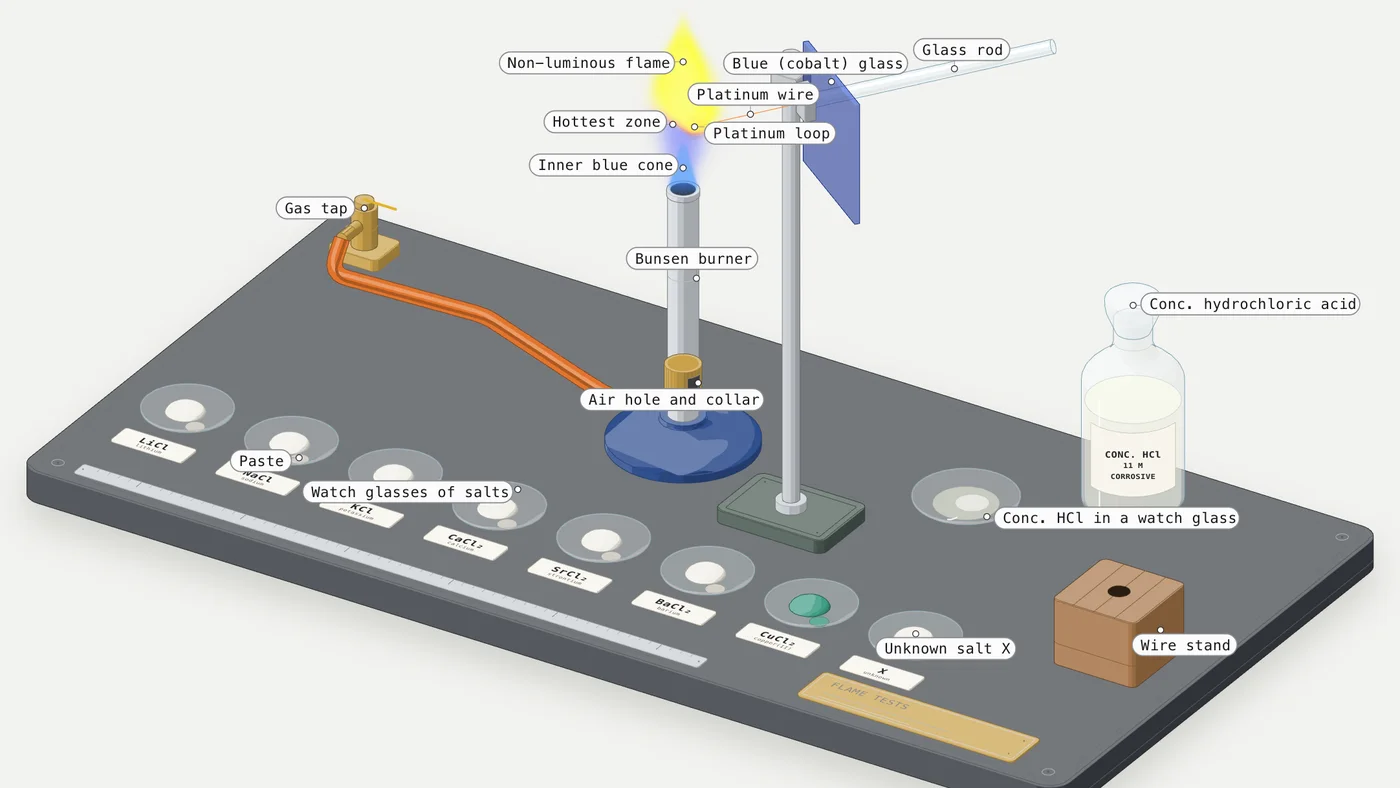
- Platinum wire with a tiny loop at one end (NCERT draws it sealed in a glass rod). Many school labs use nichrome wire, which is cheaper but may slightly alter the flame colour (LibreTexts, Flame test).
- Bunsen burner (or the burner your lab uses) giving a non-luminous flame
- Concentrated hydrochloric acid
- Two clean watch glasses
- Blue (cobalt) glass
- The given salt
Procedure
These steps are from the NCERT lab manual (NCERT Lab Manual XII, Unit 7), with notes in brackets.
- Make a tiny loop at one end of the platinum wire.
- Light the burner and open the air hole fully to get a non-luminous (blue) flame. (With the air hole closed the flame is yellow, cooler and sooty; see Common mistakes.)
- To clean the loop, dip it into concentrated hydrochloric acid and hold it in the non-luminous flame.
- Repeat step 3 until the wire gives no colour to the flame.
- Put 2 to 3 drops of concentrated hydrochloric acid on a clean watch glass and make a paste of a small quantity of the salt in it.
- Dip the clean loop in the paste and hold it in the non-luminous (oxidising) flame. (Hold it in the hot part, near the tip of the inner blue cone, which is the hottest point of the flame (LibreTexts, Laboratory Techniques).)
- Note the colour of the flame first with the naked eye, then through blue glass.
- Identify the metal ion from the chart below. Clean the wire again before the next salt.
If the colour is weak, dip the loop in the acid again and put it back in the flame for a short, bright flash (LibreTexts, Flame Tests).
Flame test colour chart
The first four rows are NCERT Table 7.8, word for word. The other rows use the IGCSE syllabus and other references, since NCERT's table does not include them.
| Metal ion | Flame colour (naked eye) | Through blue (cobalt) glass | Source |
|---|---|---|---|
| Cu²⁺ | Green flame with blue centre | Same colour as without glass | NCERT Table 7.8 |
| Sr²⁺ | Crimson red | Purple | NCERT Table 7.8 |
| Ba²⁺ | Apple green | Bluish green | NCERT Table 7.8 |
| Ca²⁺ | Brick red | Green | NCERT Table 7.8 |
| Na⁺ | Golden yellow, persistent | Not seen: the glass absorbs it | IGCSE, LibreTexts, Wikipedia |
| K⁺ | Lilac | Purple-red | IGCSE; Lange's Handbook via Science Olympiad |
| Li⁺ | Red (crimson) | Not given in our sources | IGCSE, Wikipedia |

Where references differ:
- Calcium: NCERT says brick red; IGCSE says orange-red. Through blue glass NCERT gives "green" in Table 7.8 but "greenish-yellow" in its group V confirmatory test (Table 7.16).
- Barium: NCERT Table 7.16 calls it "grassy green"; IGCSE says "light green".
- Copper: NCERT says green with a blue centre; IGCSE says blue-green.
- Sodium: IGCSE says yellow; LibreTexts calls it a "strong, persistent orange"; Wikipedia says bright yellow, golden.
- Potassium through blue glass: a Science Olympiad handout quoting Lange's Handbook of Chemistry (1952) gives "purple-red". Some books say crimson. Use your teacher's wording.
For CBSE, use the NCERT words. For IGCSE, use the syllabus words (red, yellow, lilac, orange-red, light green, blue-green).
Viewing potassium through cobalt glass
Sodium is a common contaminant, and its yellow is so strong that it dominates many flame tests (Wikipedia, Flame test). Potassium's lilac is faint, so a trace of sodium can hide it completely. Blue cobalt glass absorbs the yellow, so the potassium colour comes through (Science Olympiad, The Flame Test).
A useful reading: if a flame looks yellow to the naked eye but purple-red through blue glass, both sodium and potassium are present (Science Olympiad, The Flame Test).
Telling the two red flames apart
Strontium (crimson red) and lithium (red) look alike to the eye. NCERT gives strontium as purple through blue glass. In CBSE salt analysis lithium is not on the cation list, so a crimson flame points to Sr²⁺, which you then confirm with ammonium sulphate: a white precipitate (NCERT Lab Manual XII, Table 7.16).
Observation table: how to write it in your practical file
NCERT's specimen record writes the flame test as one row of the preliminary tests. This is its row for a salt that gave no colour:
| S. No. | Experiment | Observation | Inference |
|---|---|---|---|
| 4 | Prepared a paste of the salt with conc. HCl and performed the flame test. | No distinct colour of the flame seen. | Ca²⁺, Sr²⁺, Ba²⁺, Cu²⁺ may be absent. |
Worked example. A white salt gives a brick-red flame that looks green through blue glass.
| S. No. | Experiment | Observation | Inference |
|---|---|---|---|
| 4 | Prepared a paste of the salt with conc. HCl and performed the flame test on a clean platinum wire. Viewed the flame with the naked eye and through blue glass. | Brick-red flame; green through blue glass. | Ca²⁺ may be present. |
This is a clue, not the answer. Carry on with the cation groups. If group V gives a white precipitate with (NH₄)₂CO₃, dissolve it in acetic acid and add ammonium oxalate. A white precipitate of calcium oxalate confirms Ca²⁺, and NCERT repeats the flame test on the preserved group V precipitate (NCERT Lab Manual XII, Table 7.16). The full scheme is in the salt analysis guide.
Precautions and safety
- Wear eye protection, an apron and gloves. NCERT asks for all three in the chemistry lab (NCERT Lab Manual XII, Unit 7).
- Concentrated HCl is corrosive and a respiratory irritant (RSC, Flame tests: the wooden splint method). Use only 2 to 3 drops, keep the bottle stoppered and do not breathe the fumes. Some labs use dilute HCl for safety, though the colours are less intense (LibreTexts, Flame Tests).
- Some salts are hazardous. Strontium chloride can cause eye damage, and copper chloride can be harmful and dangerous to the environment. Avoid nitrates, which give toxic nitrogen oxides, and lead salts (RSC).
- Never use the luminous flame. It is hard to control and a hazard in the lab (LibreTexts, Laboratory Techniques). Keep hair, sleeves and papers away from the burner.
- The wire and glass rod stay hot. Put the wire back in its stand; do not touch the loop.
- Use a clean wire for each salt, and look through blue glass every time, not only when you expect potassium.
- Do this only in a school lab, with a teacher present. Do not try flame tests, concentrated acid or gas burners at home.
Common mistakes
- Sodium contamination masking the colour. Sodium is everywhere, even in dust and sweat on your fingers. Even a trace gives yellow, and its yellow is persistent (LibreTexts; RSC infographic). A short yellow flash is not proof of a sodium salt. Look through blue glass before you write anything.
- A dirty wire. A loop that still carries the last salt mixes the two colours. The RSC notes the wire must be clean to avoid an inaccurate result (RSC infographic). Keep dipping in HCl and heating until the flame shows no colour at all. A nichrome wire will always leave a trace of orange in the flame (LibreTexts), so learn what your clean wire looks like.
- A luminous flame. With the air hole closed the flame is not very hot and the gas does not burn completely; soot particles glow and make the flame yellow and luminous (LibreTexts, Laboratory Techniques). That yellow hides the test colour. Open the air hole.
- Skipping the HCl paste. Without it the salt is not turned into its volatile chloride and the colour is weak.
- Treating the flame test as proof. Mixtures can mask colours (RSC), and some colours look alike. Always confirm with the wet test.
Flame test viva questions
- Why is concentrated HCl used in the flame test? It turns the salt into its chloride, which is volatile in the non-luminous flame, so the colour is strong. It also cleans the wire.
- Why is platinum wire used? Platinum does not corrode even at high temperatures and melts at about 1768 °C (Wikipedia, Platinum), so it survives the flame and gives no colour of its own.
- Can a glass rod replace the platinum wire? No. Ordinary soda-lime glass contains about 13 to 14 per cent sodium oxide (Wikipedia, Soda-lime glass), and its sodium would colour the flame yellow.
- Why is a non-luminous flame used? It is hotter, and it has no yellow light of its own. The yellow light of the luminous flame's glowing soot hides the test colour.
- How do you know the wire is clean? It gives no colour to the flame after dipping in conc. HCl and heating.
- Why does a metal ion give a colour? Heat lifts its electrons to higher energy levels. As they fall back they give out light of definite energy, hence definite wavelength and colour.
- Why is blue cobalt glass used? It absorbs the yellow light of sodium, which is present as an impurity in most samples, so other colours, especially potassium's, can be seen.
- Which CBSE cations does the flame test point to? Cu²⁺ (green with blue centre), Sr²⁺ (crimson red), Ba²⁺ (apple green) and Ca²⁺ (brick red).
- Why is the flame test only a preliminary test? NCERT says preliminary tests are not conclusive. Colours can mask each other and some look alike, such as the reds of strontium and lithium.
- Why does NCERT preserve some group V precipitate? To do the flame test on it as part of the confirmatory tests for Ba²⁺ (grassy green), Sr²⁺ (crimson red) and Ca²⁺ (brick red).
Try it in 3D
You can practise on the free flame test virtual lab from Student Intelligence. The 3D bench and its controls work without signing in:
- Test seven chlorides (LiCl, NaCl, KCl, CaCl₂, SrCl₂, BaCl₂, CuCl₂) and an unknown salt X; "New unknown" picks a different metal for X.
- Light the burner and open or close the air hole. A closed air hole gives a yellow, sooty flame that hides the colours and soots the wire.
- Clean the platinum wire in conc. HCl. It dips and heats again until the flame shows no colour, and it warns you if the loop is still dirty, because the last salt's colour will mix in.
- Each salt carries a trace of sodium, as real ones do. Switch between the naked eye and the blue cobalt glass to see what the glass removes.
- An observation table fills in as you test: salt, flame colour, colour through the glass and the ion.
- Turn on See-through to watch atoms in the flame: an electron goes up a level, comes back down and gives out light. A small energy-level card shows the energy (eV) and wavelength (nm). The bench turns all the way round.
- A short quiz and a few flashcards sit on the same page.
The guided experiment, where the voice tutor walks you through the test, needs a free sign-in.
FAQ
What colour does calcium give in the flame test?
Brick red, by NCERT; IGCSE calls it orange-red. Through blue glass NCERT gives green (Table 7.8) or greenish-yellow (Table 7.16).
Why does potassium need cobalt glass in the flame test?
Potassium's lilac is faint, and almost every sample has a trace of sodium, whose yellow hides it. Cobalt glass absorbs the yellow, so the potassium colour shows, as purple-red.
What is the flame test colour for sodium?
Golden yellow, strong and persistent. Because even a trace of sodium gives this colour, a weak or short yellow flash usually means an impurity, not a sodium salt.
Why does magnesium not give a colour in the flame test?
Magnesium salts give no flame colour (Wikipedia, Flame test). The usual answer, from NCERT Exemplar Class 11, is that the energy of the Bunsen flame is not enough to excite its tightly held electrons (Careers360, NCERT Exemplar answer). Mg²⁺ is identified by its wet test instead.
Is the flame test asked in the CBSE Class 12 practical exam?
Yes, as part of salt analysis, which is worth 8 of the 30 practical marks (CBSE Curriculum 2026-27). Examiners often ask about it in the viva.
Want to see each colour, and what cobalt glass does to it, before your practical? Open the free flame test lab on Student Intelligence and try salt X.
Sources
- NCERT. Laboratory Manual Chemistry, Class XII, Unit 7: Systematic Qualitative Analysis ("3. Flame Test", Fig. 7.3, Table 7.8, Table 7.16, precautions, discussion questions, specimen record). https://ncert.nic.in/pdf/publication/sciencelaboratorymanuals/classXII/chemistry/lelm107.pdf
- NCERT. Chemistry Part I, Class XI, Unit 2: Structure of Atom (emission and absorption spectra, line spectra, visible range, Bohr's explanation, ΔE = Ef − Ei). https://ncert.nic.in/textbook/pdf/kech102.pdf
- CBSE. Chemistry (Subject Code 043), Curriculum 2026-27, Classes XI and XII: practical evaluation scheme and qualitative analysis cation lists. https://cbseacademic.nic.in/web_material/CurriculumMain27/SecPart2/Chemistry_SecP2_2026-27.pdf
- CISCE. ICSE Chemistry syllabus, Examination Year 2027: Class IX and Class X internal assessment of practical work. https://cisce.org/wp-content/uploads/2025/03/11.-Chemistry.pdf
- Cambridge International. Cambridge IGCSE Chemistry 0620 syllabus for 2026, 2027 and 2028: 12.5 Identification of ions, item 4, and the "Flame tests for metal ions" table. https://www.cambridgeinternational.org/Images/697205-2026-2028-syllabus.pdf
- LibreTexts Chemistry. Flame Tests (Group 1: The Alkali Metals). https://chem.libretexts.org/Bookshelves/Inorganic_Chemistry/Supplemental_Modules_and_Websites_%28Inorganic_Chemistry%29/Descriptive_Chemistry/Elements_Organized_by_Block/1_s-Block_Elements/Group__1%3A_The_Alkali_Metals/2Reactions_of_the_Group_1_Elements/Flame_Tests
- LibreTexts Chemistry. Qualitative Analysis of Common Cations in Water (Malik), 2.6: Flame test. https://chem.libretexts.org/Bookshelves/Analytical_Chemistry/Qualitative_Analysis_of_Common_Cations_in_Water_%28Malik%29/2%3A_Experimental_techniques/2.6%3A_Flame_test
- LibreTexts Chemistry. General Chemistry Labs II, 1.1: Introduction to Laboratory Techniques (the Bunsen burner). https://chem.libretexts.org/Ancillary_Materials/Laboratory_Experiments/Wet_Lab_Experiments/General_Chemistry_Labs/General_Chemistry_Labs_II/01.01%3A_Introduction_to_Laboratory_Techniques
- Royal Society of Chemistry. Flame tests (the wooden splint method): health and safety notes. https://edu.rsc.org/experiments/flame-tests-the-wooden-splint-method/759.article
- Royal Society of Chemistry. How to carry out flame tests (infographic). https://edu.rsc.org/infographics/how-to-carry-out-flame-tests/4024075.article
- NIST. Handbook of Basic Atomic Spectroscopic Data: strong lines of sodium, potassium and lithium. https://physics.nist.gov/PhysRefData/Handbook/Tables/sodiumtable2.htm, https://physics.nist.gov/PhysRefData/Handbook/Tables/potassiumtable2.htm, https://physics.nist.gov/PhysRefData/Handbook/Tables/lithiumtable2.htm
- Science Olympiad. The Flame Test (handout; colour list from Lange's Handbook of Chemistry, 8th edition, 1952). https://www.soinc.org/sites/default/files/uploaded_files/flametest.pdf
- Wikipedia. Flame test. https://en.wikipedia.org/wiki/Flame_test
- Wikipedia. Platinum. https://en.wikipedia.org/wiki/Platinum
- Wikipedia. Soda-lime glass. https://en.wikipedia.org/wiki/Soda%E2%80%93lime_glass
- Careers360. NCERT Exemplar Class 11, The s-Block Elements: why beryllium and magnesium do not colour the flame. https://learn.careers360.com/ncert/question-why-do-beryllium-and-magnesium-not-impart-colour-to-the-flame-in-the-flame-test