
Acid-base titration
Find the strength of NaOH with oxalic acid: the standard solution, the titration, the calculation and the viva.
By Rahul Sain · Updated Nov 3, 2026
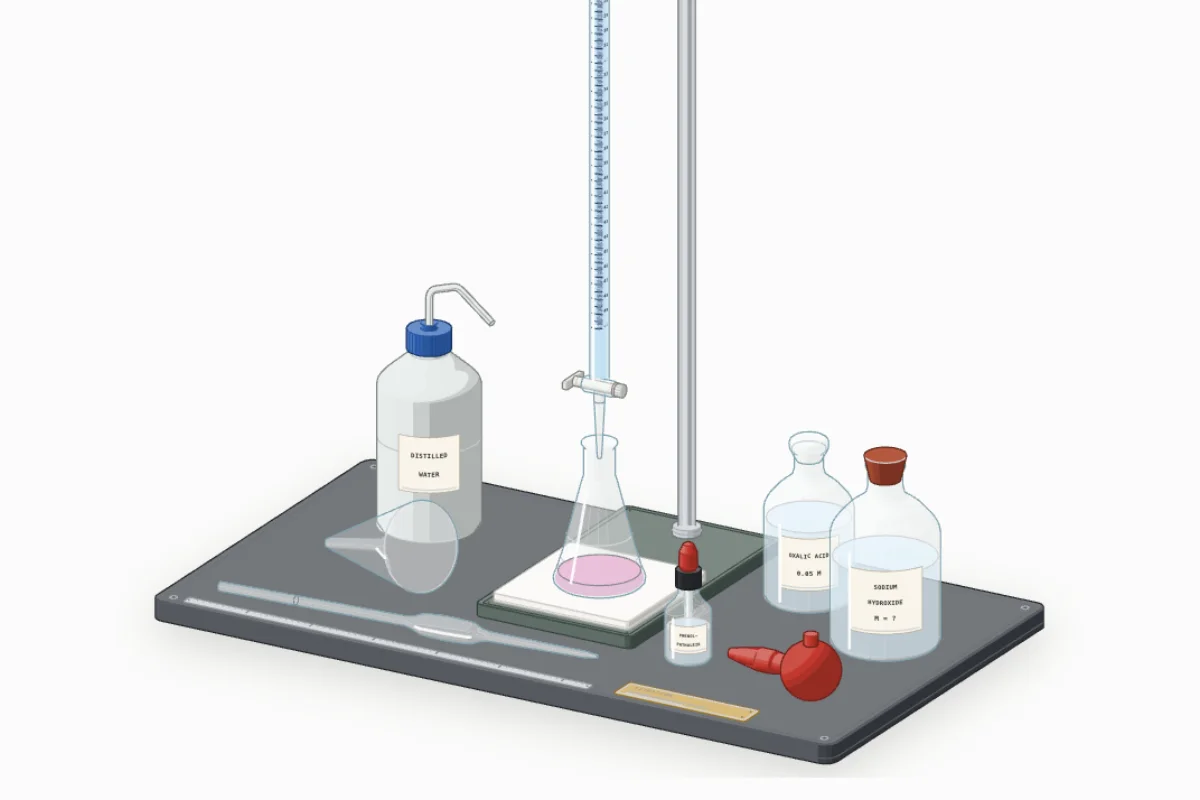 Free 3D labTry it in the 3D labAcid-base titration: take the readings yourself, free, no sign-in needed.
In the Class 11 acid-base titration you find the strength of a sodium hydroxide solution by titrating it against a standard oxalic acid solution, with phenolphthalein as the indicator. You run NaOH from a burette into 10 mL of oxalic acid until one drop turns the flask a faint permanent pink. Then you use a₁M₁V₁ = a₂M₂V₂ to get the molarity, and multiply by 40 to get the strength in g/L.
This guide follows the NCERT Laboratory Manual Chemistry Class XI (Experiment 6.1) and the CBSE Chemistry syllabus for 2026-27. It is laid out the way a practical file is written.
Quick answers
- What CBSE lists: preparing a standard oxalic acid solution; finding the strength of NaOH against it; preparing a standard sodium carbonate solution; finding the strength of HCl against it. Volumetric analysis carries 8 of the 30 practical marks.
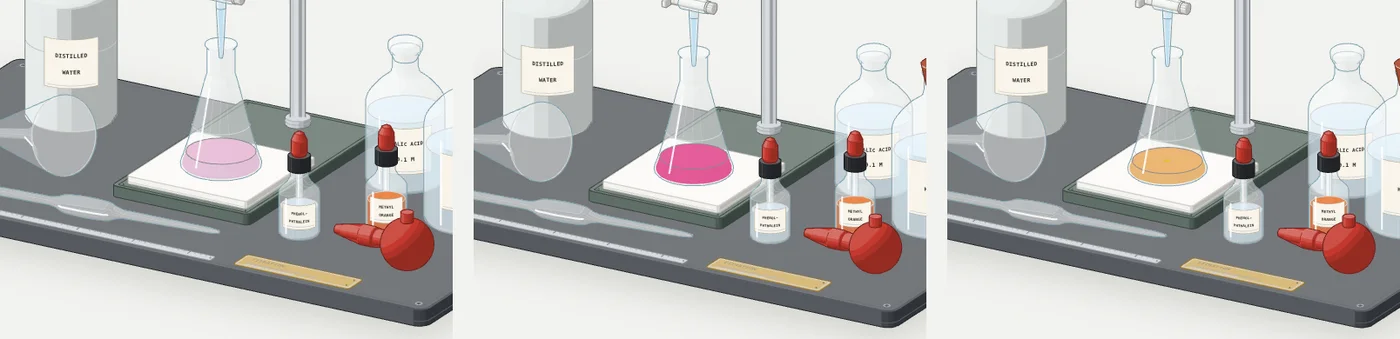
- Indicator: phenolphthalein for oxalic acid vs NaOH (colourless to faint pink). Methyl orange for sodium carbonate vs HCl (yellow to pinkish red).
- Formula: a₁M₁V₁ = a₂M₂V₂, with a₁ = 2 (basicity of oxalic acid) and a₂ = 1 (acidity of NaOH). Strength in g/L = M × 40.
- Standard solution: 3.1500 g of oxalic acid dihydrate (M = 126 g/mol) in 250 mL gives 0.1 M.
- Concordant readings: NCERT says repeat until you get three concordant readings. ISC requires two consecutive titres that are exactly equal.
Where titration sits in each syllabus
CBSE Class 11. Section E, "Quantitative Estimation", of the 2026-27 syllabus lists using a balance, then the four experiments in the Quick answers above. Section C offers one more option: "Study the pH change in the titration of a strong base using a universal indicator."
CBSE Class 12. Titration here is redox: KMnO₄ against oxalic acid or ferrous ammonium sulphate.
ISC. The ISC Class XII practical is also redox only (KMnO₄ against ammonium iron(II) sulphate or oxalic acid). Its rule for concordant readings is strict: "two consecutive values which are exactly the same", and an average is not accepted.
ICSE Class 10. The ICSE 2027 syllabus names "Neutralisation of an alkali (titration)" only as a way to prepare salts, and says details of apparatus and procedure are not required.
IGCSE 0620. Section 12.2 of the 2026-2028 syllabus asks you to describe a titration using a burette, a volumetric pipette and a suitable indicator, and to identify the end point. IGCSE names thymolphthalein, not phenolphthalein, and uses cm³.
Aim
To determine the strength (concentration) of a given sodium hydroxide solution by titrating it against a standard 0.1 M solution of oxalic acid.
Theory
Neutralisation
Oxalic acid is a weak, dibasic acid: each molecule gives two H⁺ ions. Sodium hydroxide is a strong base that gives one OH⁻ per formula unit. They react as:
(COOH)₂ + 2NaOH → (COONa)₂ + 2H₂O
So one mole of oxalic acid needs two moles of NaOH.
Equivalence point and end point
The NCERT manual defines the equivalence point as the point where the reaction is complete, also called the theoretical or stoichiometric end point. The end point is where you actually see the indicator change colour. In an ideal titration the two coincide. In practice there is a small gap, which NCERT calls the titration error. You choose the indicator so that this gap is as small as possible.
Why phenolphthalein, and when methyl orange
An indicator should change colour close to the pH at the equivalence point. LibreTexts gives two key facts:
- Phenolphthalein is colourless below about pH 8.3 and pink above it.
- Methyl orange changes from red to yellow between pH 3.1 and 4.4.
When a weak acid is titrated with a strong base, the pH at equivalence is above 7. That is why phenolphthalein suits oxalic acid vs NaOH, and methyl orange does not: methyl orange finishes changing colour long before the acid is used up.
The NCERT manual's rules for choosing an indicator:
| Titration | Indicator |
|---|---|
| Weak acid vs strong base (oxalic acid vs NaOH) | Phenolphthalein |
| Strong acid vs weak base (HCl vs Na₂CO₃) | Methyl orange |
| Strong acid vs strong base (HCl vs NaOH) | Either |
| Weak acid vs weak base | No suitable indicator |
Molarity, and where normality fits
The syllabus and the NCERT Class 11 textbook (Unit 1) use molarity: moles of solute per litre of solution. The lab manual writes the titration equation as:
a₁M₁V₁ = a₂M₂V₂
Here a₁, M₁ and V₁ are the basicity, molarity and volume of the acid, and a₂, M₂ and V₂ are the acidity, molarity and volume of the base.
Normality appears only in a "Know this also" box in the manual, which shows N = a × M, so N₁V₁ = N₂V₂ is the same equation. 0.1 M oxalic acid is 0.2 N. For diluting one substance, a₁ = a₂ and it becomes the textbook's M₁V₁ = M₂V₂.
Apparatus and chemicals
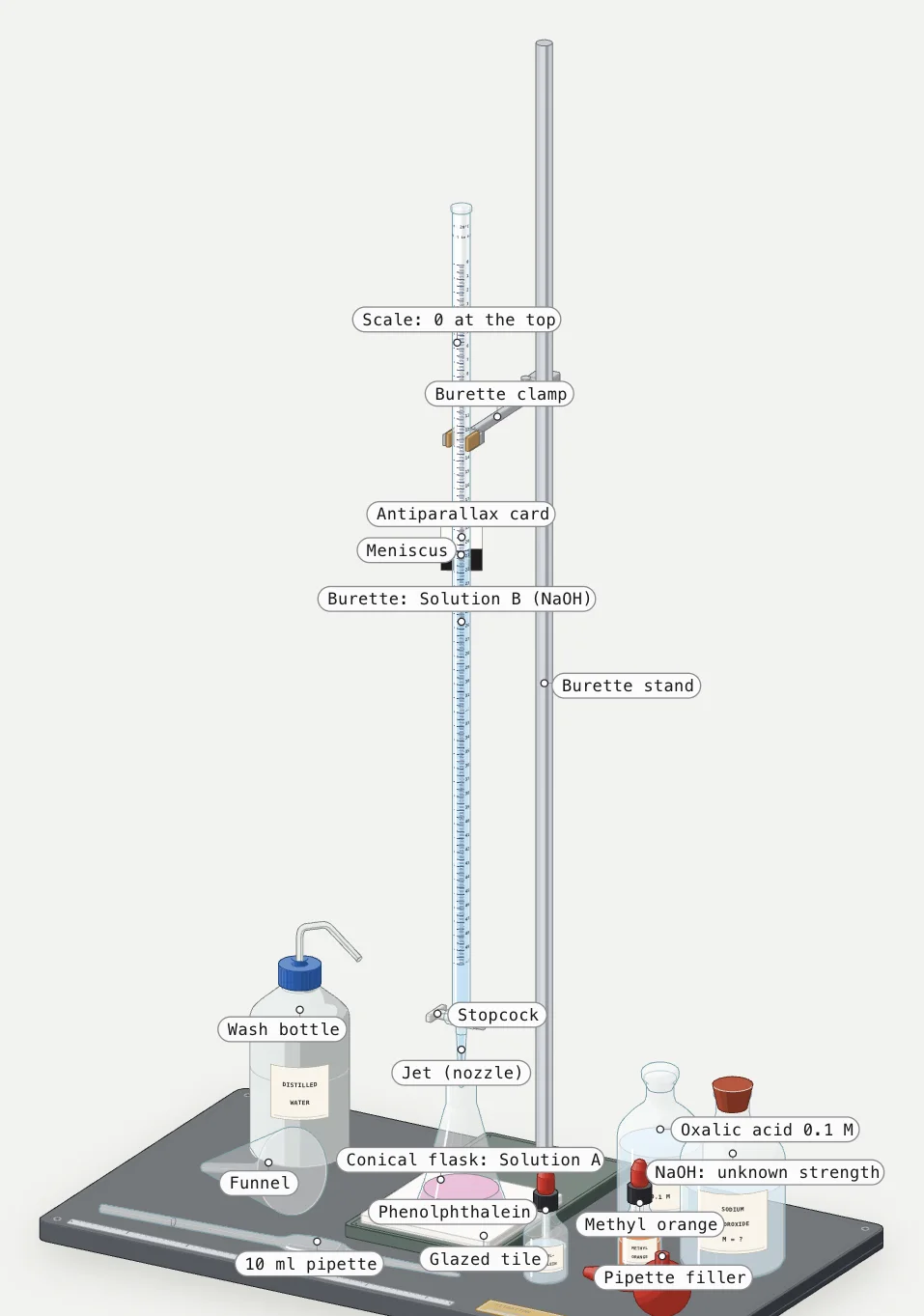
NCERT's list for Experiment 6.1: burette (50 mL), pipette (10 mL), conical flask (100 mL), burette stand, funnel, white glazed tile, measuring flask (100 mL), oxalic acid, sodium hydroxide solution and phenolphthalein.
For the standard solution (Experiment 2.1) add a 250 mL measuring flask, a watch glass or weighing tube, a wash bottle and a balance. You will also use a pipette filler bulb and an antiparallax card, both described in Unit 2 of the manual.
Preparing the standard oxalic acid solution
Oxalic acid is stable enough to be a primary standard, so it can be weighed out directly. NaOH is a secondary standard: its strength has to be found by titration, which is the point of this experiment.
The mass calculation
The crystals are hydrated oxalic acid, (COOH)₂·2H₂O, with molar mass 126 g/mol. As a check: 2(1.008) + 2(12.011) + 4(15.999) + 2(18.015) = 126.06 g/mol.
Mass needed = molarity × volume in litres × molar mass
For 250 mL of 0.1 M:
- Moles needed = 0.1 mol/L × 0.250 L = 0.0250 mol
- Mass = 0.0250 mol × 126 g/mol = 3.1500 g
This matches NCERT Experiment 2.1. Check with the manual's formula, Molarity = (mass × 1000) ÷ (molar mass × volume in mL): (3.1500 × 1000) ÷ (126 × 250) = 0.1 M.
Other volumes and strengths you may be asked for:
| Solution | Working | Mass |
|---|---|---|
| 100 mL of 0.1 M | 0.1 × 0.100 × 126 | 1.2600 g |
| 250 mL of 0.05 M (M/20) | 0.05 × 0.250 × 126 | 1.5750 g |
| 100 mL of 0.1 M Na₂CO₃ (M = 106) | 0.1 × 0.100 × 106 | 1.0600 g |
Steps (NCERT Experiment 2.1)
- Weigh a clean, dry watch glass, then 3.1500 g of oxalic acid on it, to four decimal places.
- Transfer the acid through a funnel into a clean 250 mL measuring flask. Reweigh the empty watch glass: the difference is the mass transferred, and you calculate the exact molarity from it.
- Wash the funnel into the flask several times with distilled water, keeping the water below a quarter of the flask's volume for now.
- Swirl until the solid dissolves. Add distilled water up to the etched mark, adding the last few mL dropwise, until the bottom of the meniscus touches the mark.
- Stopper the flask, shake it well, and label it "0.1 M oxalic acid".
Procedure
Based on NCERT Experiment 6.1 and the burette and pipette technique in Unit 2.
- Clean and rinse the burette. Wash it with distilled water, then rinse it with a few mL of the NaOH, wetting the whole inner surface, and drain the rinsings through the nozzle.
- Fill the burette. Clamp it vertically in the burette stand and fill it with NaOH through a funnel to above the zero mark.
- Clear the air bubble. Open the stopcock wide and let the solution run out fast until no air is left in the nozzle.
- Remove the funnel. A funnel left in place can drip and change the reading. Make sure no drop is hanging from the nozzle.
- Take the initial reading. Hold an antiparallax card (a white card, half blackened) behind the burette so the black part just touches the meniscus. Keep your eye level with the meniscus and read the bottom of the curve. The initial reading does not have to be 0.00.
- Pipette the acid. Rinse the pipette with water, then with the oxalic acid. Use a filler bulb to draw the acid above the mark. Let it down until the meniscus sits on the mark, then run it into a conical flask washed with distilled water. Do not blow out the last drop: the pipette is calibrated with that drop left in.
- Add the indicator. Add 1-2 drops of phenolphthalein and place the flask on the white glazed tile.
- Titrate. Add NaOH in larger amounts at first, then drop by drop, swirling all the time. Work the stopcock with your thumb and two fingers, pressing the plug slightly inward so it doesn't leak. Stop at the first very faint pink that stays.
- Take the final reading at the lower meniscus, at eye level.
- Repeat until you get three concordant readings.
Many teachers also ask for a fast rough titration first, so the accurate runs can go quickly to about 1 mL short of it and then drop by drop. NCERT doesn't require one; follow your teacher.
Observation table
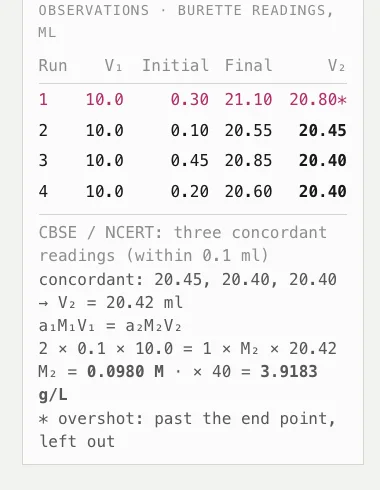
This is NCERT's Table 6.1, filled in with example readings (10 mL pipette, 0.1 M oxalic acid). Your own readings will differ.
Table: Titration of sodium hydroxide vs oxalic acid solution
| Sl. No. | Volume of oxalic acid taken, V₁ (mL) | Initial burette reading, x (mL) | Final burette reading, y (mL) | Volume of NaOH used, V₂ = (y − x) (mL) | Concordant reading (mL) |
|---|---|---|---|---|---|
| Rough | 10.0 | 0.00 | 20.90 | 20.90 | — |
| 1 | 10.0 | 0.30 | 20.70 | 20.40 | |
| 2 | 10.0 | 0.10 | 20.50 | 20.40 | 20.40 |
| 3 | 10.0 | 0.45 | 20.85 | 20.40 |
The rough titre is left out. It was run fast and overshot.
Burette readings are written to two decimal places. On a burette marked every 0.1 mL you can estimate to the nearest 0.05 mL, so the second decimal is 0 or 5.
Calculation
Molarity equation:
a₁M₁V₁ = a₂M₂V₂ (oxalic acid on the left, sodium hydroxide on the right)
Values:
- a₁ = 2 (basicity of oxalic acid)
- M₁ = 0.1 M
- V₁ = 10.0 mL
- a₂ = 1 (acidity of NaOH)
- V₂ = 20.40 mL
- M₂ = ?
Substitute:
2 × 0.1 × 10.0 = 1 × M₂ × 20.40
2.0 = 20.40 × M₂
M₂ = 2.0 ÷ 20.40 = 0.098039… ≈ 0.0980 M
Strength in g/L = molarity × molar mass of NaOH:
Strength = 0.098039 × 40 = 3.92157… ≈ 3.9216 g/L
Use the unrounded molarity here: the rounded 0.0980 × 40 gives 3.9200 g/L, which is off at the fourth decimal that NCERT asks for.
Check by moles. 10.0 mL of 0.1 M oxalic acid is 0.0010 mol. The reaction needs twice that much NaOH, 0.0020 mol. That amount is in 20.40 mL, so the concentration is 0.0020 ÷ 0.02040 L = 0.0980 M. The two methods agree.
HCl vs Na₂CO₃ (NCERT Experiment 6.3) uses the same equation, with Na₂CO₃ (acidity 2) in the flask and HCl (basicity 1) in the burette. Example: if 10.0 mL of 0.1 M Na₂CO₃ needs 19.80 mL of HCl, then 2 × 0.1 × 10.0 = 1 × M × 19.80 and M = 0.1010 M.
Result
The concentration (strength) of the given NaOH solution is 3.9216 g/L (molarity 0.0980 M).
Precautions
From NCERT Experiment 6.1:
- Rinse the burette and pipette with the solutions they will hold. Rinse the conical flask with distilled water only.
- Remove the air gap and make sure the nozzle is full. Remove the funnel and leave no hanging drop before reading.
- Read the lower meniscus for colourless solutions and the upper one for dark solutions such as KMnO₄, with your eye level with it.
- Never hold the pipette by its bulb, and never use a pipette or burette with a broken nozzle.
- Keep the pipette tip under the liquid while drawing it up, and don't blow out the last drop.
- Calculate the strength to the fourth decimal place.
Safety:
- Never pipette by mouth. NCERT says never to suck a strong acid or an alkali into a pipette, and to use a pipette filler bulb for corrosive or poisonous solutions.
- Protect your eyes. Sodium hydroxide attacks skin and especially eyes. The Royal Society of Chemistry classes even 0.4 M NaOH as an irritant and asks for eye protection throughout.
- Wipe up spills at once, tell your teacher, and wash any splash on your skin with plenty of water.
- Never taste or touch lab chemicals.
- Do this experiment only in a school lab under supervision, never at home.
Common mistakes and how they change your answer
Every error comes through V₂, because here M₂ = 2.0 ÷ V₂. A titre that is too big gives a molarity that is too small, and the other way round.
| Mistake | What happens to V₂ | Effect on M₂ |
|---|---|---|
| Overshooting: deep pink instead of faint pink | Too large (one extra drop of 0.05 mL makes 20.45) | Too low (0.0978 instead of 0.0980 M) |
| An air bubble in the burette tip that comes out during titration | The reading falls by more than the liquid actually delivered, so V₂ is too large | Too low |
| Burette rinsed with water, not NaOH | NaOH is diluted, so more is needed | Too low |
| Parallax: reading from above the meniscus | Reads a larger number (burette marks increase downwards). On the initial reading this makes V₂ too small; on the final reading, too large | Either way; don't rely on errors cancelling |
| Pipette rinsed with water, not acid | The acid is diluted, so less base is needed | Too high |
| Conical flask rinsed with oxalic acid | Extra acid in the flask, so V₂ is too large | Too high (the calculation still assumes 10.0 mL) |
| Methyl orange instead of phenolphthalein | It turns yellow well before equivalence, so V₂ is much too small | Much too high |
Two things that do not change the answer: rinsing the flask's walls with distilled water near the end (the moles of acid stay the same), and an initial reading that isn't zero, as long as you subtract it.
Viva questions with answers
- Why can't you make a standard NaOH solution by weighing? NaOH takes up moisture and carbon dioxide from the air, so a weighed amount isn't pure NaOH. NCERT calls it a secondary standard.
- Why rinse the burette and pipette with their own solutions? Water left inside would dilute the solution and change its concentration.
- What is the end point, and how is it different from the equivalence point? The end point is where the indicator changes colour. The equivalence point is where acid and base have exactly reacted. The small difference between them is the titration error.
- Why phenolphthalein here, and not methyl orange? For a weak acid against a strong base the pH at equivalence is above 7. Phenolphthalein turns pink above about pH 8.3. Methyl orange changes at pH 3.1-4.4, which is too early.
- Why are both indicators fine for HCl vs NaOH? For a strong acid and a strong base, the pH jumps sharply across both indicators' ranges at the equivalence point.
- What are the basicity of oxalic acid and the acidity of NaOH? 2 and 1: the number of replaceable H⁺ per molecule of acid and of OH⁻ per formula unit of base.
- Why not blow out the last drop of the pipette? The pipette is calibrated to deliver its stated volume with that drop left in the tip.
- What are concordant readings? Titres that agree with each other. NCERT asks for three. ISC defines them as two consecutive titres that are exactly the same.
- Could you put oxalic acid in the burette instead? Yes, but the end point would be pink to colourless, which is harder to see accurately.
Try it in 3D
The Student Intelligence titration lab is a 3D bench you can turn all the way round: a 50 mL burette of NaOH of unknown strength, an antiparallax card, and 10.0 mL of 0.1 M oxalic acid on a glazed tile. On it you can:
- Set up the bench in eight steps: rinse the burette, fill it, take out the funnel, run out the air bubble, remove the hanging drop, rinse the pipette, pipette the acid, and add the indicator.
- Titrate: run the base fast or drop by drop (0.05 mL a drop), and swirl the flask.
- Read the burette to the nearest 0.05 mL. Each refill starts a little below zero, so you practise subtracting a real initial reading.
- Build the observation table. Overshot runs, and runs done with the wrong indicator, are marked and left out. You can switch between the CBSE and ISC concordance rules, and the bench works out the molarity and the g/L strength using a₁M₁V₁ = a₂M₂V₂.
- Try the wrong indicator. Switch to methyl orange and the flask turns yellow at about 16 mL, well short of the end point at about 20.4 mL. This shows why it's the wrong choice here.
- See the ions. A see-through view shows H⁺ and OH⁻ pairing up into water.
The bench and its controls are free to use without an account, and so are a short quiz and a set of flashcards. The guided experiment with the tutor needs a free sign-in.
FAQ
Which titrations are in the CBSE Class 11 practical?
Oxalic acid vs NaOH with phenolphthalein, and sodium carbonate vs HCl with methyl orange, each after you prepare the standard solution. Class 12 moves to KMnO₄ redox titrations.
How much oxalic acid do I weigh for 0.1 M?
3.1500 g of (COOH)₂·2H₂O for 250 mL, or 1.2600 g for 100 mL, using the hydrated molar mass of 126 g/mol.
Why does the pink colour fade when I swirl?
The NaOH that just landed makes the solution alkaline where it hits. Swirling mixes it with acid that hasn't reacted yet, so the pink goes. Near the end point the pink lasts longer, because less acid is left. The end point is the first faint pink that stays after swirling.
Should I use molarity or normality?
Use molarity and a₁M₁V₁ = a₂M₂V₂, as in the NCERT lab manual and the syllabus. Normality (N = a × M) gives the same answer.
If you want to check your understanding before the practical exam, explaining the steps aloud to Student Intelligence's tutor is one way to find the gaps.
Sources
- Central Board of Secondary Education. Chemistry (043), Classes XI-XII, 2026-27 (curriculum). https://cbseacademic.nic.in/web_material/CurriculumMain27/SecPart2/Chemistry_SecP2_2026-27.pdf
- NCERT. Laboratory Manual Chemistry Class XI, Unit 2: Basic Laboratory Techniques (burette, pipette, antiparallax card; Experiment 2.1). https://ncert.nic.in/pdf/publication/sciencelaboratorymanuals/classXI/chemistry/kelm202.pdf
- NCERT. Laboratory Manual Chemistry Class XI, Unit 6: Titrimetric Analysis (Experiments 6.1-6.3). https://ncert.nic.in/pdf/publication/sciencelaboratorymanuals/classXI/chemistry/kelm206.pdf
- NCERT. Chemistry Part I, Class XI, Unit 1: Some Basic Concepts of Chemistry (molarity). https://ncert.nic.in/textbook/pdf/kech101.pdf
- CISCE. ISC Chemistry (862), Class XII syllabus. https://cisce.org/wp-content/uploads/2025/04/17.-Chemistry.pdf
- CISCE. ICSE 2027 Chemistry syllabus. https://cisce.org/wp-content/uploads/2025/03/11.-Chemistry.pdf
- Cambridge International. Cambridge IGCSE Chemistry 0620, syllabus for 2026-2028. https://www.cambridgeinternational.org/Images/697205-2026-2028-syllabus.pdf
- LibreTexts Chemistry. 17.3: Acid-Base Indicators (Petrucci et al., General Chemistry). https://chem.libretexts.org/Bookshelves/General_Chemistry/Map%3A_General_Chemistry_%28Petrucci_et_al.%29/17%3A_Additional_Aspects_of_Acid-Base_Equilibria/17.3%3A_Acid-Base_Indicators
- Royal Society of Chemistry. Titrating sodium hydroxide with hydrochloric acid (Education practical). https://edu.rsc.org/experiments/titrating-sodium-hydroxide-with-hydrochloric-acid/697.article