
Salt analysis
Find the one anion and one cation in a salt, test by test, with a worked practical record and viva answers.
By Rahul Sain · Updated Nov 3, 2026
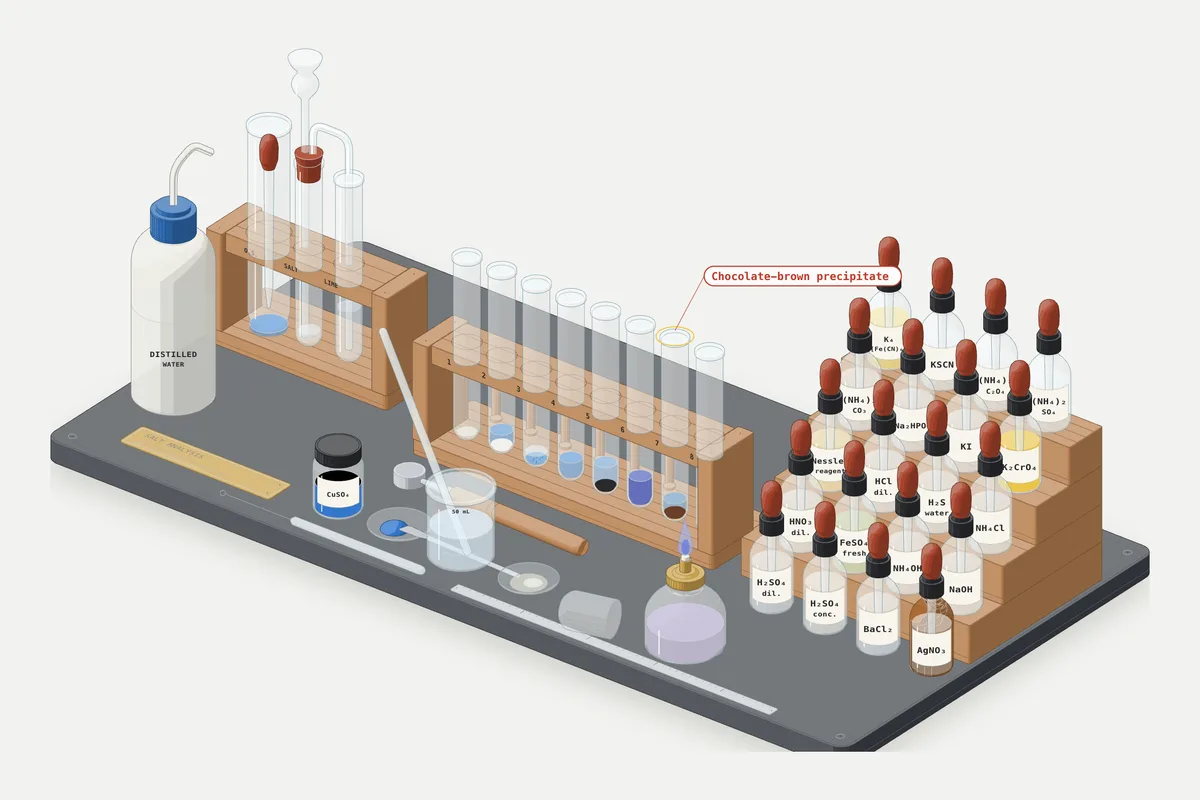 Free 3D labTry it in the 3D labSalt analysis: take the readings yourself, free, no sign-in needed.
Salt analysis means finding the one anion (acid radical) and the one cation (basic radical) in an inorganic salt you are given. You work in a fixed order: preliminary tests, anion tests, cation group tests, then a confirmatory test for each ion. In the CBSE Class 12 practical exam it is worth 8 of the 30 marks (CBSE Curriculum 2026-27).
This guide follows Unit 7 of the NCERT Laboratory Manual Chemistry Class XII (NCERT Lab Manual XII, Unit 7). Where your school's method differs, follow your teacher.
Quick answers
- Order: preliminary tests (colour, smell, dry heating, flame test, borax bead), anions (dil. H₂SO₄ group, conc. H₂SO₄ group, sulphate and phosphate), cations (group zero to VI), confirmatory tests.
- Group reagents: zero: none (NaOH test for NH₄⁺); I: dil. HCl; II: H₂S in dil. HCl; III: NH₄OH with NH₄Cl; IV: H₂S with NH₄OH; V: (NH₄)₂CO₃ with NH₄OH; VI: none (Na₂HPO₄ test for Mg²⁺).
- The key rule: test the groups in order and stop at the first group that gives a precipitate.
- Marks (CBSE Class 12): salt analysis 8 marks; class record and viva 4 marks, out of 30.
Which ions are in the CBSE syllabus
CBSE 2026-27 Class 12 practical K is "Determination of one anion and one cation in a given salt", insoluble salts excluded (CBSE Curriculum 2026-27):
- Cations: Pb²⁺, Cu²⁺, Al³⁺, Fe³⁺, Mn²⁺, Ni²⁺, Zn²⁺, Co²⁺, Ca²⁺, Sr²⁺, Ba²⁺, Mg²⁺, NH₄⁺
- Anions: CO₃²⁻, S²⁻, SO₃²⁻, NO₃⁻, NO₂⁻, Cl⁻, Br⁻, I⁻, SO₄²⁻, PO₄³⁻, CH₃COO⁻, C₂O₄²⁻
Aim
To detect one cation and one anion in the given salt.
Apparatus and reagents
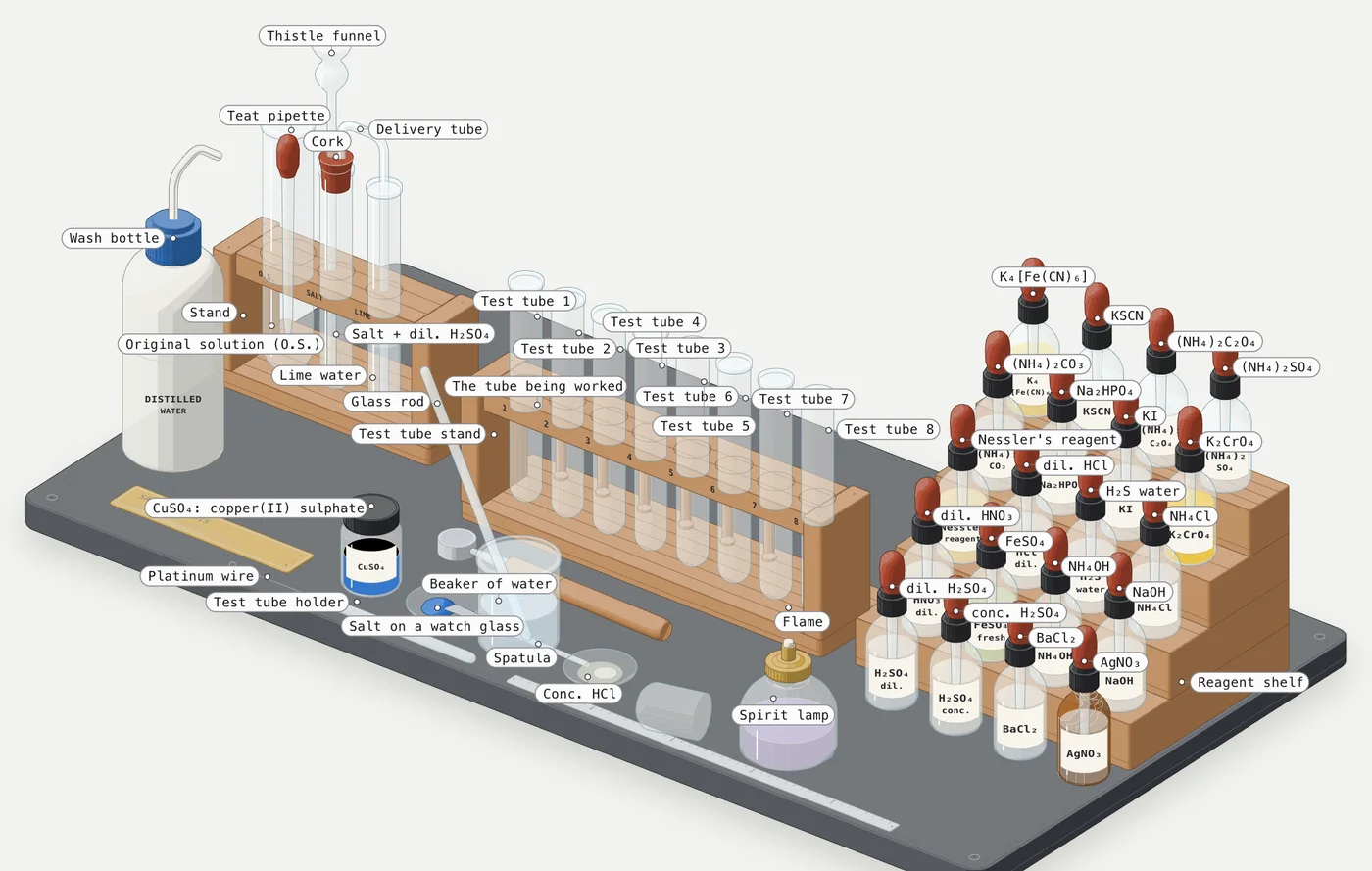
Boiling tubes, test tubes, a measuring cylinder, a test tube stand and holder, a delivery tube, corks and filter paper, as NCERT lists them. You also need a platinum wire, a watch glass, a burner, lime water, a glass rod, a wash bottle of distilled water, and H₂S (NCERT makes the gas in a Kipp's apparatus). The reagents are named in each test below.
Theory
A precipitate forms when the ionic product of a salt exceeds its solubility product (K_sp). The ionic product is controlled by the common ion effect: a shift in equilibrium when you add a substance that supplies an ion already present (NCERT Chemistry Class XI, Unit 6). Each group reagent sets conditions where only that group's ions exceed their K_sp, which is called selective precipitation (LibreTexts, Separation of cations in groups).
Procedure: preliminary tests
NCERT says these tests are not conclusive, but they give clues and take about 10 to 15 minutes.
Physical examination
| Colour of salt | Cation indicated |
|---|---|
| Light green, yellow, brown | Fe²⁺, Fe³⁺ |
| Blue | Cu²⁺ |
| Bright green | Ni²⁺ |
| Blue, red, violet, pink | Co²⁺ |
| Light pink | Mn²⁺ |
A white salt means these ions are probably absent. A smell of ammonia hints at NH₄⁺; vinegar hints at acetate.
Dry heating test
Heat about 0.1 g of dry salt in a dry test tube for a minute. Note the colour hot and cold.
| Cold | Hot | Inference |
|---|---|---|
| Blue | White | Cu²⁺ |
| Green | Dirty white or yellow | Fe²⁺ |
| White | Yellow | Zn²⁺ |
| Pink | Blue | Co²⁺ |
Flame test
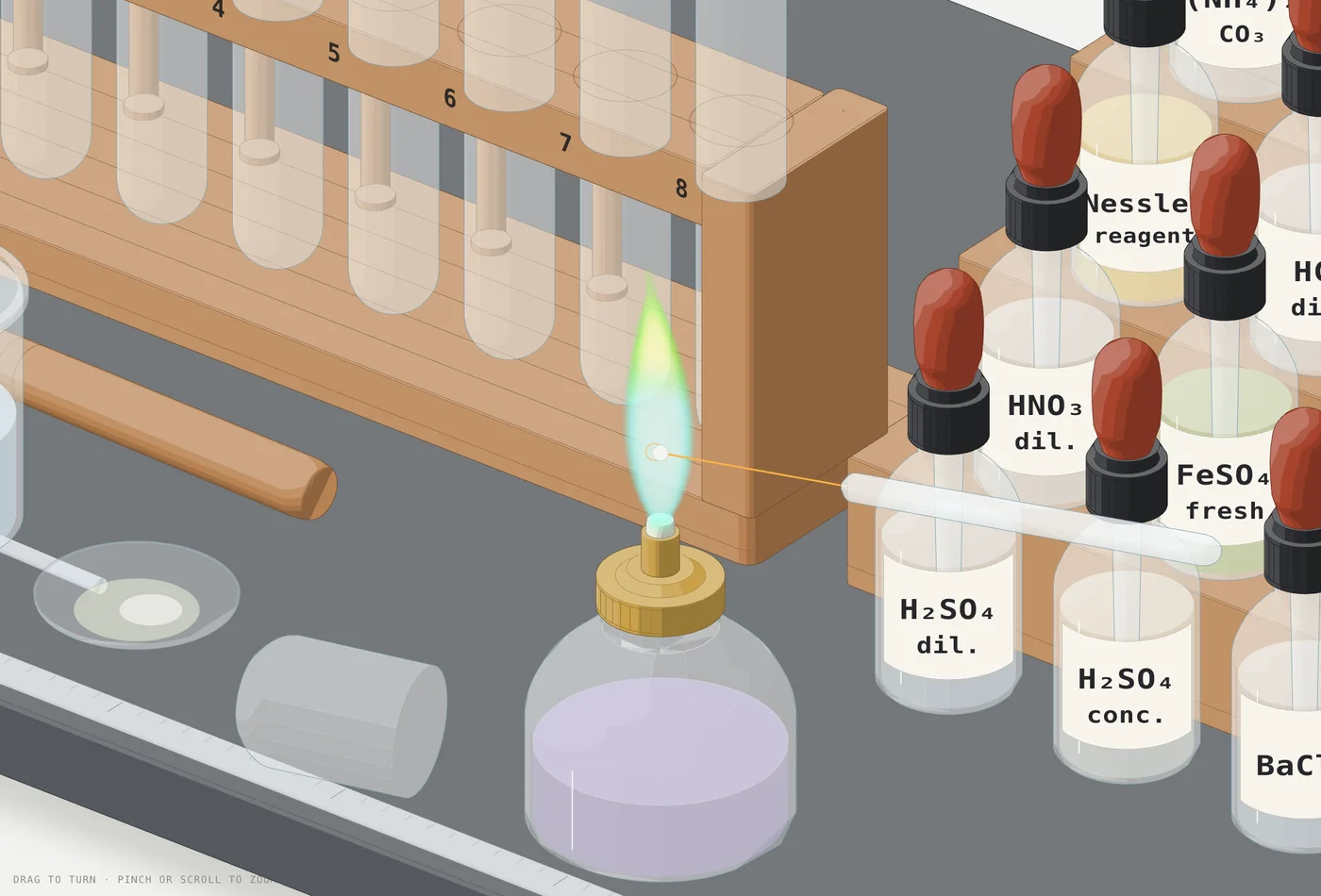
Clean the platinum loop in conc. HCl and a non-luminous flame until it gives no colour. Dip it in a paste of the salt in 2 to 3 drops of conc. HCl and hold it in the flame. HCl is used because metal chlorides are volatile.
| Naked eye | Through blue glass | Inference |
|---|---|---|
| Green with blue centre | Same | Cu²⁺ |
| Crimson red | Purple | Sr²⁺ |
| Apple green | Bluish green | Ba²⁺ |
| Brick red | Green | Ca²⁺ |
Borax bead test
Only for coloured salts. Make a clear, colourless borax bead on the hot platinum loop, touch it to a little salt and heat again. In the oxidising flame: Cu²⁺ green hot, blue cold; Mn²⁺ light violet; Fe³⁺ yellowish brown hot, yellow cold; Ni²⁺ violet hot, reddish brown cold.
Procedure: anion analysis
Step I: dilute H₂SO₄ group
Take 0.1 g of salt in a test tube and add 1 to 2 mL of dilute H₂SO₄. Watch in the cold, then warm.
| Observation | Gas | Anion indicated |
|---|---|---|
| Brisk effervescence; colourless, odourless gas turns lime water milky | CO₂ | CO₃²⁻ |
| Smell of rotten eggs; lead acetate paper turns black | H₂S | S²⁻ |
| Smell of burning sulphur; acidified K₂Cr₂O₇ turns green | SO₂ | SO₃²⁻ |
| Brown fumes; turn KI-starch paper blue | NO₂ | NO₂⁻ |
| Smell of vinegar; vapours turn blue litmus red | CH₃COOH | CH₃COO⁻ |
Step II: concentrated H₂SO₄ group
If Step I is negative, warm 0.1 g of salt with 3 to 4 drops of conc. H₂SO₄.
| Observation | Gas | Anion indicated |
|---|---|---|
| Colourless pungent gas; dense white fumes with a rod dipped in NH₄OH | HCl | Cl⁻ |
| Reddish brown vapours, stronger with MnO₂ | Br₂ | Br⁻ |
| Violet vapours; turn starch paper blue | I₂ | I⁻ |
| Light brown fumes, much denser with copper turnings; solution turns blue | NO₂ | NO₃⁻ |
| Colourless gas turns lime water milky and burns with a blue flame | CO + CO₂ | C₂O₄²⁻ |
Step III: sulphate and phosphate
If Steps I and II are negative, test the water extract for SO₄²⁻ (BaCl₂) and PO₄³⁻ (ammonium molybdate). For a water-insoluble salt NCERT uses a sodium carbonate extract: 1 g salt boiled with 3 g Na₂CO₃ in 15 mL water for 10 minutes, then filtered.
Confirmatory tests for anions
| Anion | Test | Observation |
|---|---|---|
| CO₃²⁻ | Salt + dil. H₂SO₄, gas through lime water | Milky; milkiness clears with excess gas |
| S²⁻ | Extract made alkaline + sodium nitroprusside | Purple or violet colour |
| SO₃²⁻ | Extract + BaCl₂ | White ppt, dissolves in dil. HCl giving SO₂; decolourises acidified KMnO₄ |
| NO₂⁻ | Extract + KI + starch, acidified with acetic acid | Blue colour |
| CH₃COO⁻ | Salt + neutral FeCl₃ solution | Deep red colour; brown-red ppt on boiling |
| Cl⁻ | Extract + dil. HNO₃ + AgNO₃ | Curdy white ppt, soluble in NH₄OH |
| Br⁻ | Extract + dil. HNO₃ + AgNO₃ | Pale yellow ppt, soluble in NH₄OH with difficulty |
| I⁻ | Extract + dil. HNO₃ + AgNO₃ | Yellow ppt, insoluble in NH₄OH |
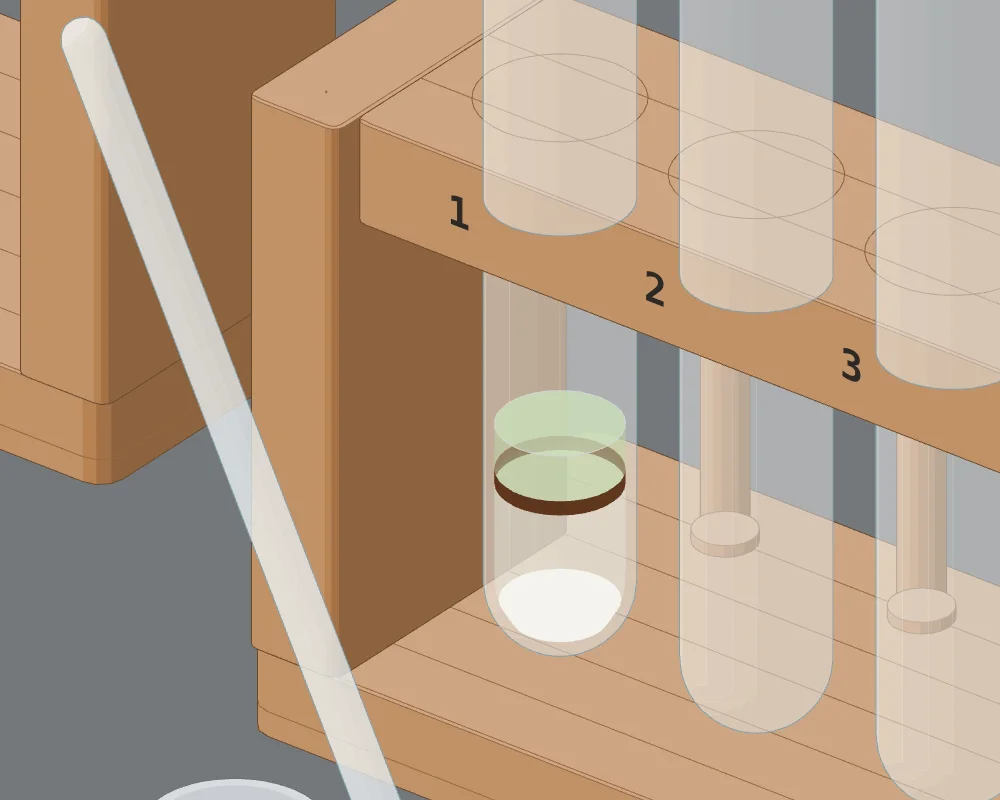
| NO₃⁻ | Brown ring test (below) | Dark brown ring at the junction |
| C₂O₄²⁻ | Extract + acetic acid + CaCl₂ | White ppt; the ppt decolourises warm acidified KMnO₄ |
| SO₄²⁻ | Extract + dil. HCl + BaCl₂ | White ppt insoluble in conc. HCl or conc. HNO₃ |
| PO₄³⁻ | Extract + conc. HNO₃ + ammonium molybdate, boil | Canary yellow ppt |
Brown ring test: to 1 mL of salt solution add 2 mL of conc. H₂SO₄ slowly, mix and cool under the tap. Pour freshly prepared FeSO₄ solution slowly down the side of the tube without shaking.
Anion equations
- Na₂CO₃ + H₂SO₄ → Na₂SO₄ + H₂O + CO₂
- Ca(OH)₂ + CO₂ → CaCO₃ + H₂O (milky); CaCO₃ + CO₂ + H₂O → Ca(HCO₃)₂ (clears)
- Na₂S + H₂SO₄ → Na₂SO₄ + H₂S; (CH₃COO)₂Pb + H₂S → PbS + 2CH₃COOH
- Na₂SO₃ + H₂SO₄ → Na₂SO₄ + H₂O + SO₂
- K₂Cr₂O₇ + H₂SO₄ + 3SO₂ → K₂SO₄ + Cr₂(SO₄)₃ (green) + H₂O
- NaCl + H₂SO₄ → NaHSO₄ + HCl; HCl + NH₃ → NH₄Cl (white fumes)
- NaCl + AgNO₃ → AgCl + NaNO₃; AgCl + 2NH₄OH → [Ag(NH₃)₂]Cl + 2H₂O
- NaNO₃ + H₂SO₄ → NaHSO₄ + HNO₃; 4HNO₃ → 4NO₂ + O₂ + 2H₂O
- 6FeSO₄ + 3H₂SO₄ + 2HNO₃ → 3Fe₂(SO₄)₃ + 4H₂O + 2NO; FeSO₄ + NO → [Fe(NO)]SO₄ (brown ring)
- (COONa)₂ + H₂SO₄ → Na₂SO₄ + H₂O + CO₂ + CO
- CaCl₂ + Na₂C₂O₄ → CaC₂O₄ + 2NaCl
- Na₂SO₄ + BaCl₂ → BaSO₄ + 2NaCl
Procedure: cation analysis
Original solution (O.S.)
Make a clear solution of the salt. Try each solvent in order, hot if needed, and move on only if the salt does not dissolve: water, dil. HCl, conc. HCl, dil. HNO₃, then aqua regia (conc. HCl and conc. HNO₃, 3:1).
Group zero: NH₄⁺
Heat 0.1 g of salt with 1 to 2 mL of NaOH. A smell of ammonia and white fumes with a rod dipped in HCl show NH₄⁺.
Groups I to VI
| Group | Cations | Group reagent | Precipitate as |
|---|---|---|---|
| Zero | NH₄⁺ | None | (NaOH test) |
| I | Pb²⁺ | Dilute HCl | Chloride |
| II | Pb²⁺, Cu²⁺, As³⁺ | H₂S gas in presence of dil. HCl | Sulphide |
| III | Al³⁺, Fe³⁺ | NH₄OH in presence of NH₄Cl | Hydroxide |
| IV | Co²⁺, Ni²⁺, Mn²⁺, Zn²⁺ | H₂S in presence of NH₄OH | Sulphide |
| V | Ba²⁺, Sr²⁺, Ca²⁺ | (NH₄)₂CO₃ in presence of NH₄OH | Carbonate |
| VI | Mg²⁺ | None | (Na₂HPO₄ test) |
(As³⁺ is in the NCERT table but not in the CBSE cation list.)
The group separation logic
- Add dil. HCl to the O.S. A white precipitate means group I (PbCl₂). If none, go on.
- Pass H₂S through the same acidified solution. A precipitate means group II. Black means Cu²⁺ or Pb²⁺.
- If none, take fresh O.S. NCERT heats it with 2 to 3 drops of conc. HNO₃ to oxidise any Fe²⁺ to Fe³⁺. Cool, add solid NH₄Cl, then excess NH₄OH. Reddish brown precipitate is Fe³⁺; gelatinous white is Al³⁺.
- If none, pass H₂S through that ammoniacal solution. White means Zn²⁺, flesh coloured (buff) means Mn²⁺, black means Ni²⁺ or Co²⁺.
- If none, take fresh O.S., add NH₄Cl, excess NH₄OH, then (NH₄)₂CO₃. A white precipitate means group V.
- If none, test for Mg²⁺.
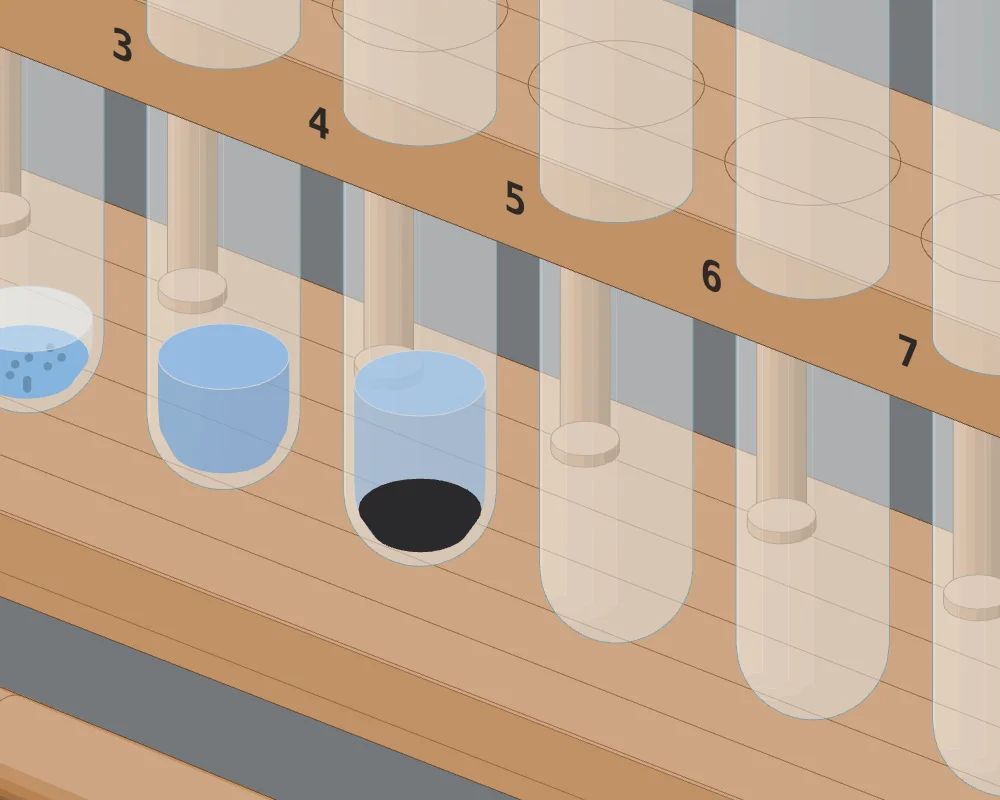
Lead is listed in both groups I and II. PbCl₂ dissolves in hot water, so some Pb²⁺ can stay in solution and come down later as black PbS.
The conditions decide what precipitates. In group II the acid keeps S²⁻ low, so only sulphides with very low K_sp (CuS, PbS) come down; in group IV the ammonia raises S²⁻ enough for ZnS and MnS (LibreTexts). In group III, NH₄⁺ from NH₄Cl suppresses the ionisation of NH₄OH, so only the least soluble hydroxides, Fe(OH)₃ and Al(OH)₃, precipitate.
Confirmatory tests for cations
NCERT runs these on the group precipitate, dissolved as directed.
| Cation | Test | Observation |
|---|---|---|
| NH₄⁺ | Gas from NaOH + heat passed into Nessler's reagent | Brown precipitate |
| Pb²⁺ | Hot solution of group I ppt + KI | Yellow ppt |
| Pb²⁺ | Hot solution + K₂CrO₄ | Yellow ppt, soluble in NaOH |
| Cu²⁺ | Group II ppt dissolved in HNO₃, + excess NH₄OH | Deep blue solution |
| Cu²⁺ | Blue solution + acetic acid + K₄[Fe(CN)₆] | Chocolate brown ppt |
| Fe³⁺ | Ppt dissolved in dil. HCl + K₄[Fe(CN)₆] | Prussian blue ppt or colour |
| Fe³⁺ | Same solution + KSCN | Blood red colour |
| Al³⁺ | Ppt dissolved in dil. HCl + NaOH | White gelatinous ppt, soluble in excess |
| Al³⁺ | Blue litmus + NH₄OH dropwise (lake test) | Blue floating mass in colourless solution |
| Zn²⁺ | Ppt dissolved in dil. HCl + NaOH | White ppt, soluble in excess |
| Zn²⁺ | Neutralised solution + K₄[Fe(CN)₆] | Bluish white ppt |
| Mn²⁺ | Ppt dissolved in dil. HCl + excess NaOH | White ppt that turns brown on keeping |
| Ni²⁺ | Ammoniacal solution + dimethylglyoxime | Bright red ppt |
| Co²⁺ | Solution + acetic acid + solid KNO₂ | Yellow ppt |
| Ba²⁺ | Group V ppt in acetic acid + K₂CrO₄ | Yellow ppt; flame grassy green |
| Sr²⁺ | Same + (NH₄)₂SO₄, heat and scratch | White ppt; flame crimson red |
| Ca²⁺ | Same + ammonium oxalate | White ppt; flame brick red |
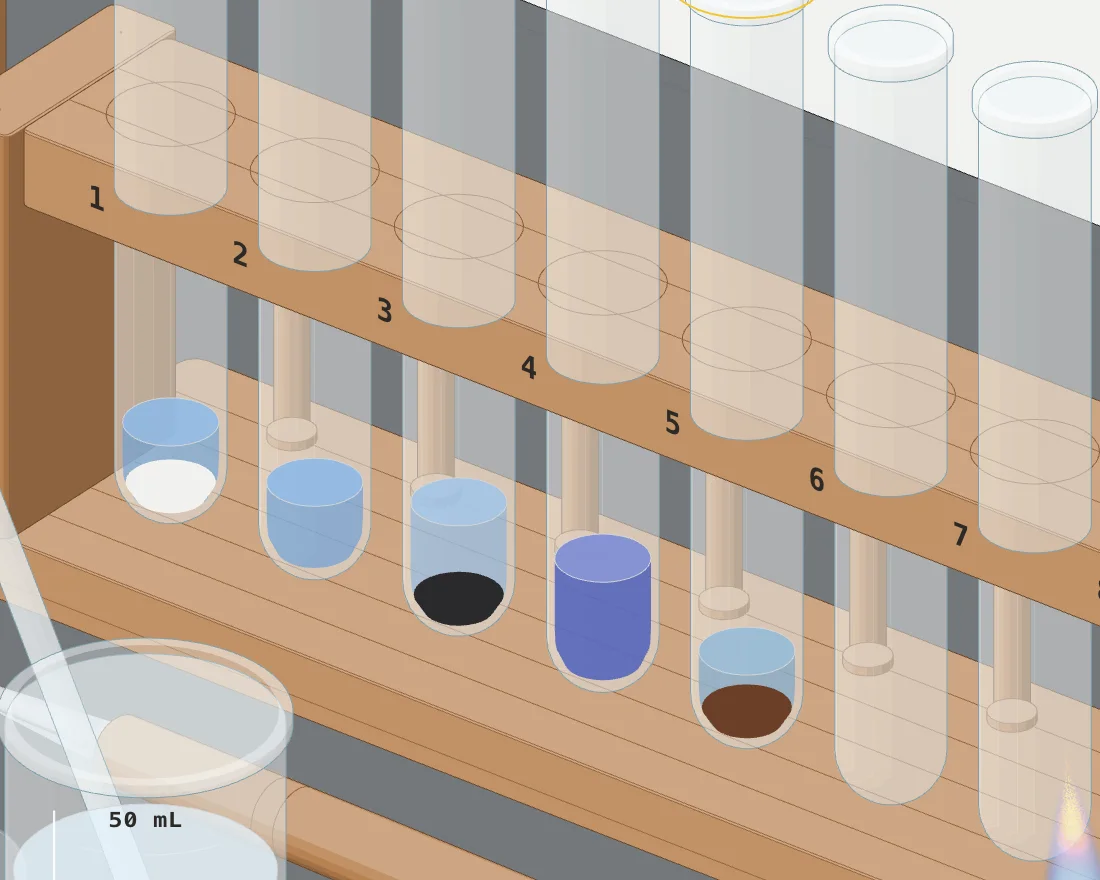
| Mg²⁺ | O.S. + NH₄OH + Na₂HPO₄, scratch the tube | White crystalline ppt |
Cation equations
- (NH₄)₂SO₄ + 2NaOH → Na₂SO₄ + 2NH₃ + 2H₂O; NH₃ + HCl → NH₄Cl
- Pb(NO₃)₂ + 2HCl → PbCl₂ + 2HNO₃; PbCl₂ + 2KI → PbI₂ + 2KCl; PbCl₂ + K₂CrO₄ → PbCrO₄ + 2KCl
- CuSO₄ + H₂S → CuS + H₂SO₄; Cu²⁺ + 4NH₃ → [Cu(NH₃)₄]²⁺ (deep blue)
- 2CuSO₄ + K₄[Fe(CN)₆] → Cu₂[Fe(CN)₆] + 2K₂SO₄
- FeCl₃ + 3NH₄OH → Fe(OH)₃ + 3NH₄Cl; 4FeCl₃ + 3K₄[Fe(CN)₆] → Fe₄[Fe(CN)₆]₃ + 12KCl; Fe³⁺ + SCN⁻ → [Fe(SCN)]²⁺
- AlCl₃ + 3NaOH → Al(OH)₃ + 3NaCl; Al(OH)₃ + NaOH → NaAlO₂ + 2H₂O
- ZnCl₂ + 2NaOH → Zn(OH)₂ + 2NaCl; Zn(OH)₂ + 2NaOH → Na₂ZnO₂ + 2H₂O; 2ZnCl₂ + K₄[Fe(CN)₆] → Zn₂[Fe(CN)₆] + 4KCl
- MnCl₂ + 2NaOH → Mn(OH)₂ + 2NaCl; Mn(OH)₂ + [O] → MnO(OH)₂ (brown)
- BaCO₃ + 2CH₃COOH → (CH₃COO)₂Ba + H₂O + CO₂; (CH₃COO)₂Ba + K₂CrO₄ → BaCrO₄ + 2CH₃COOK
- (CH₃COO)₂Sr + (NH₄)₂SO₄ → SrSO₄ + 2CH₃COONH₄
- (CH₃COO)₂Ca + (NH₄)₂C₂O₄ → CaC₂O₄ + 2CH₃COONH₄
- MgSO₄ + Na₂HPO₄ + NH₄OH → Mg(NH₄)PO₄ + Na₂SO₄ + H₂O
Worked example: copper(II) sulphate
Written the way a practical file records it, in the format of the NCERT specimen record.
Aim: To analyse the given salt for one anion and one cation.
| S. No. | Experiment | Observation | Inference |
|---|---|---|---|
| 1 | Noted the colour of the salt | Blue | Cu²⁺ may be present |
| 2 | Noted the smell of the salt | No specific smell | S²⁻, SO₃²⁻, CH₃COO⁻ may be absent |
| 3 | Heated a little salt in a dry test tube | Blue salt turns white | Cu²⁺ may be present |
| 4 | Flame test with a paste of the salt in conc. HCl | Green flame with blue centre | Cu²⁺ may be present |
| 5 | Borax bead test, oxidising flame | Bead green when hot, blue when cold | Cu²⁺ may be present |
| 6 | 0.1 g salt + dil. H₂SO₄, warmed | No effervescence, no gas | CO₃²⁻, S²⁻, SO₃²⁻, NO₂⁻, CH₃COO⁻ absent |
| 7 | 0.1 g salt + conc. H₂SO₄, warmed | No gas evolved | Cl⁻, Br⁻, I⁻, NO₃⁻, C₂O₄²⁻ absent |
| 8 | Salt solution + conc. HNO₃, warmed, + ammonium molybdate | No yellow ppt | PO₄³⁻ absent |
| 9 | Salt solution + dil. HCl + BaCl₂ | White ppt, insoluble in conc. HCl | SO₄²⁻ present |
| 10 | 0.1 g salt + NaOH, heated | No smell of ammonia | NH₄⁺ absent |
| 11 | Dissolved the salt in water (O.S.) | Clear blue solution | Water soluble salt |
| 12 | O.S. + dil. HCl | No white ppt | Group I absent |
| 13 | Passed H₂S through the solution of step 12 | Black ppt | Group II present (Cu²⁺ or Pb²⁺) |
| 14 | Black ppt boiled with dil. HNO₃, + alcohol and dil. H₂SO₄ | No white ppt | Pb²⁺ absent |
| 15 | To the solution of step 14 added excess NH₄OH | Deep blue solution | Cu²⁺ present |
| 16 | Blue solution + acetic acid + K₄[Fe(CN)₆] | Chocolate brown ppt | Cu²⁺ confirmed |
Result: The given salt contains Anion: SO₄²⁻ and Cation: Cu²⁺. The salt is CuSO₄.
Groups III to VI were not tested, because the precipitate came in group II.
Precautions and safety
From NCERT's list, plus what these tests need (NCERT Lab Manual XII, Unit 7):
- Wear an apron, eye protection and gloves.
- Read every label; never use an unlabelled reagent.
- Never taste a chemical. To smell a gas, fan the vapour gently towards your nose.
- Never point a test tube at yourself or a neighbour while heating it or adding a reagent.
- Always add acid to water when diluting, never water to acid.
- Use the minimum quantity of each reagent, drop by drop.
- Use H₂S only in a fume cupboard or where your teacher directs. It is poisonous, can kill at high concentrations, and deadens your sense of smell, so its smell is no warning (OSHA, Hydrogen Sulfide Hazards).
- Concentrated H₂SO₄, HCl and HNO₃ are corrosive. Warm conc. H₂SO₄ tests gently.
- Nessler's reagent contains mercury, and lead and barium salts are toxic. Dispose of them as your teacher says, not down the sink.
- Rinse test tubes with distilled water between tests, and clean the platinum wire with conc. HCl before each flame test. Wash your hands when you finish.
Do these tests only in a school laboratory with a teacher present. None of them are safe to try at home.
Common mistakes and how examiners spot them
- Testing every group. Once a group precipitates, stop and confirm. Results for later groups show the examiner you do not know the scheme.
- Writing "white ppt" as if it settles the question. PbCl₂, BaSO₄, AgCl, Al(OH)₃, ZnS, BaCO₃ and MgNH₄PO₄ are all white. The group and the reagent decide what it is.
- Reading milkiness after H₂S as group II. Fe³⁺ oxidises H₂S to sulphur, which looks milky white or pale yellow (2Fe³⁺ + H₂S → 2Fe²⁺ + S + 2H⁺). A group II precipitate is a black sulphide.
- Skipping the acid before BaCl₂. BaCO₃ and BaSO₃ are also white. Acidifying first dissolves them, so only BaSO₄ stays.
- Not boiling off H₂S before group III. If you use the group II solution for group III, leftover H₂S gives S²⁻ once NH₄OH is added, and group IV sulphides come down in group III.
- Adding NaOH all at once. Al(OH)₃ and Zn(OH)₂ dissolve in excess, so you miss the precipitate.
- No confirmatory test. Every ion in your result needs a "confirmed" line in the record.
Salt analysis viva questions
From the NCERT discussion questions at the end of Unit 7.
- Why is dilute H₂SO₄ preferred over dilute HCl for testing anions? HCl is volatile and adds Cl⁻, so its fumes confuse the tests. H₂SO₄ is not volatile.
- Can a glass rod replace the platinum wire in the flame test? No. Glass contains sodium, whose golden-yellow flame hides other colours.
- CO₂ and SO₂ both turn lime water milky. How do you tell them apart? CO₂ is odourless. SO₂ smells of burning sulphur and turns acidified K₂Cr₂O₇ green.
- What is the brown ring? Nitroso ferrous sulphate, [Fe(NO)]SO₄, formed at the junction of the two layers.
- Why is NH₄Cl added before NH₄OH in group III? The common ion NH₄⁺ suppresses the ionisation of NH₄OH, keeping OH⁻ low, so only Fe(OH)₃ and Al(OH)₃ precipitate.
- Why does ZnS not precipitate in group II? H⁺ from HCl suppresses the ionisation of H₂S, so S²⁻ stays too low for ZnS. Only very low K_sp sulphides like CuS precipitate.
- Why is the O.S. heated with conc. HNO₃ before group III? To oxidise Fe²⁺ to Fe³⁺, which precipitates completely as Fe(OH)₃.
- Why is AgNO₃ stored in dark bottles? Light decomposes it, depositing silver.
- What is Nessler's reagent? An alkaline solution of potassium tetraiodomercurate(II), K₂HgI₄.
- Why are group V ions tested in the order Ba²⁺, Sr²⁺, Ca²⁺? Ba²⁺ also gives white precipitates in the Sr²⁺ and Ca²⁺ tests, so it is ruled out first.
Try it in 3D
You can practise the wet tests on the free salt analysis virtual lab from Student Intelligence. The 3D bench and its controls work without signing in:
- Choose one of 12 salts, or "Salt X", which picks one of them at random and hides its name until you identify it.
- Pick any of 8 test tubes and add the salt, water, the original solution, or any of 20 labelled reagents.
- Heat the tube, hold a glass rod dipped in NH₄OH or HCl at its mouth, and do the flame test on the platinum wire.
- Each addition is worked out from the ions in the tube: precipitate colours, dissolving in excess, effervescence, fumes, the brown ring.
- Turn on See-through to watch the ions meet and form a precipitate. The bench turns all the way round.
- A short quiz and a few flashcards sit on the same page.
The bench covers 11 of the 13 CBSE cations (no Ni²⁺ or Co²⁺) and four anions: CO₃²⁻, Cl⁻, NO₃⁻ and SO₄²⁻. It uses H₂S water instead of H₂S gas from a Kipp's apparatus. The guided experiment, where the tutor walks you through the tests in NCERT's order, needs a free sign-in.
FAQ
What is the difference between a group reagent and a confirmatory test?
A group reagent precipitates a whole group under set conditions, like H₂S in dilute HCl for group II. A confirmatory test then picks out one ion, like the deep blue colour for Cu²⁺.
Why do we prepare an original solution?
The cation wet tests need the ions in solution. Try water first, then the acids in the order given above.
Which salts are given in the CBSE practical exam?
CBSE does not name the salts. It lists the ions and excludes insoluble salts, so expect a soluble salt of one listed cation and one listed anion.
Is salt analysis in Class 11 the same?
Almost. The CBSE 2026-27 Class 11 list (practical F) has the same 13 cations and the same anions, except oxalate (C₂O₄²⁻), which only Class 12 adds. A much shorter list, with NH₄⁺ as the only cation, is for visually challenged students.
Want to run the tests yourself before the exam? Open the free salt analysis lab on Student Intelligence and try Salt X.
Sources
- NCERT. Laboratory Manual Chemistry, Class XII, Unit 7: Systematic Qualitative Analysis (Experiment 7.1, Tables 7.1 to 7.16, flow chart, precautions, discussion questions, specimen record). https://ncert.nic.in/pdf/publication/sciencelaboratorymanuals/classXII/chemistry/lelm107.pdf
- CBSE. Chemistry (Subject Code 043), Curriculum 2026-27, Classes XI and XII: practical evaluation scheme and qualitative analysis lists for Classes XI and XII. https://cbseacademic.nic.in/web_material/CurriculumMain27/SecPart2/Chemistry_SecP2_2026-27.pdf
- NCERT. Chemistry Part I, Class XI, Unit 6: Equilibrium (6.11.8 Common ion effect; 6.13.2 Common ion effect on solubility). https://ncert.nic.in/textbook/pdf/kech106.pdf
- LibreTexts Chemistry. Qualitative Analysis of Common Cations in Water (Malik), 1.5: Separation of cations in groups. https://chem.libretexts.org/Bookshelves/Analytical_Chemistry/Qualitative_Analysis_of_Common_Cations_in_Water_%28Malik%29/1%3A_Chemical_Principles/1.5%3A_Separation_of_cations_in_groups
- Occupational Safety and Health Administration (OSHA). Hydrogen Sulfide: Hazards. https://www.osha.gov/hydrogen-sulfide/hazards